Do businesses need a background verification API? Yes, API integration for background verification can enhance corporate efficiency.
Businesses have transitioned from manual "folder-and-file" systems to real-time API integration.
Earlier, human resource departments had to spend weeks on physical document collection and manual reference calls. This caused delays in hiring and increased the risk of document forgery.
Now modern businesses are moving towards digital solutions for background verification to establish trust. However, this move has brought an important question for business teams to answer. Is the use of a background verification API legal?
In 2026, legal frameworks support technology for due diligence while requiring strict data privacy protocols.
With a background verification API, an employer can validate credentials through authoritative sources. This can reduce the legal risk of negligent hiring.
Here’s how businesses can stay within the law while leveraging the power of automated verification.
Decoding the Legal Landscape for Background Verification APIs
Several legislative pillars in India define the legality of background verification.
Originally, the Information Technology Act, 2000 combined with the Sensitive Personal Data or Information (SPDI) Rules had set the groundwork for digital data handling.
More recently, the Digital Personal Data Protection (DPDP) Act of 2023 is the main regulator for all digital personal data processing. Under these laws, the act of a business verifying a candidate's background is legal when conducted with explicit consent, purpose disclosure, and security safeguards.
The law views any employer who bears the responsibility for the safe handling of a "Data Principal’s" (candidate's) information as a "Data Fiduciary".
The background verification process would remain protected under the Indian Contract Act and privacy laws only as long as the business does not access data through illegal means. These can be hacking or unauthorised database purchases.
The Anchor of API Compliance
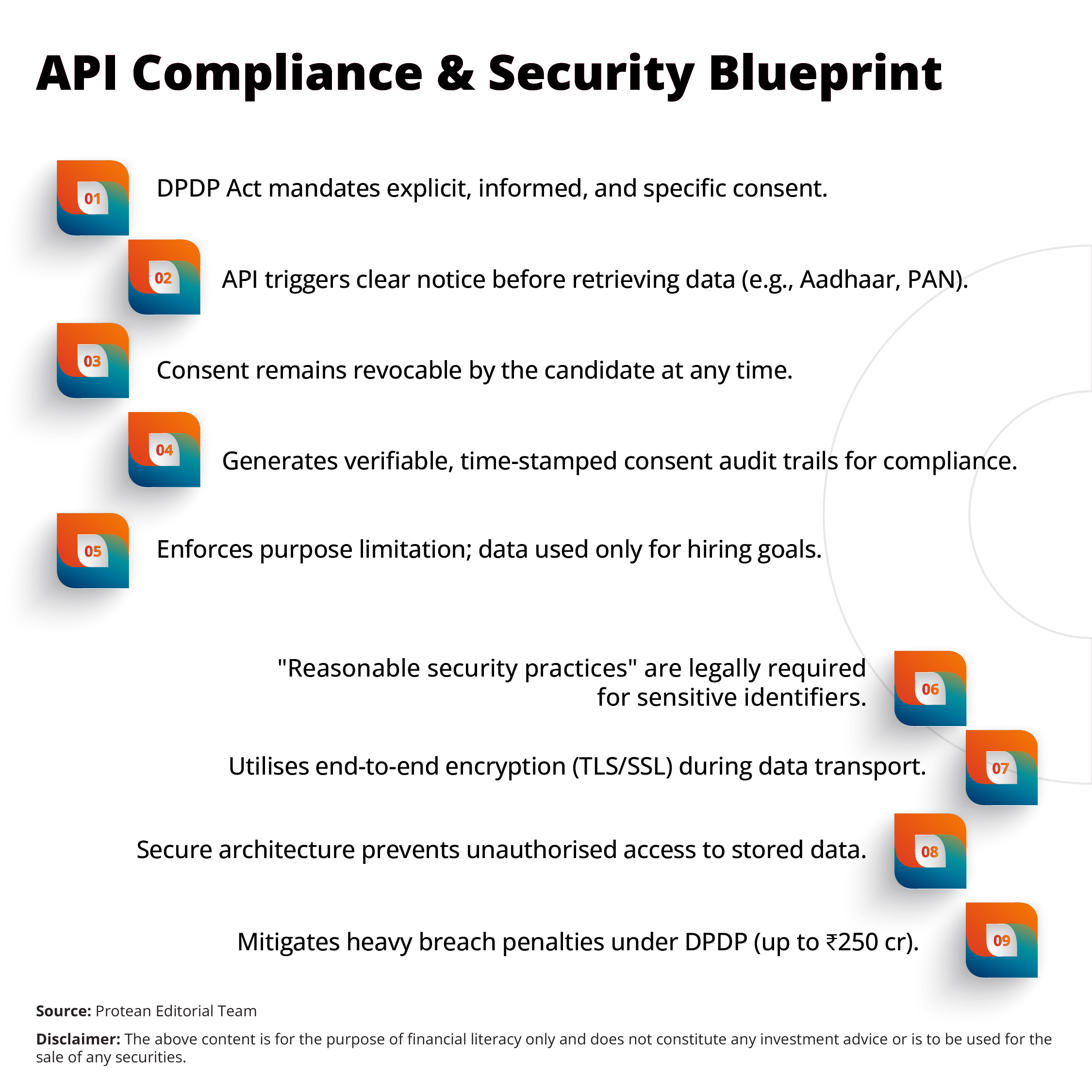
The DPDP Act has mandated that consent be explicit, informed, and specific. A generic clause stated subtly in an employment contract will no longer suffice for high-level digital checks.
Using background verification API, the system needs to trigger a clear notice to the candidate before retrieving any data. This notice describes exactly what data points the system will verify, such as:
- Aadhaar details
- PAN validity
- Past employment records through the UAN (EPFO) database
Moreover, the law requires that consent should remain revocable. A candidate possesses the right to withdraw their permission at any time.
An API-led workflow creates an immutable, time-stamped audit trail of the consent provided. Thus, it offers superior legal protection compared to verbal or unrecorded manual agreements.
This digital record proves that the business respected the individual's privacy rights throughout the background verification process. Purpose limitation restricts data collected for hiring to that purpose only, preventing use for other commercial activities without fresh consent.
Technical Security as a Legal Requirement
Technical security is a legal requirement under modern data protection regimes. Businesses performing background verification handle sensitive identifiers like bank account numbers and government ID details.
There is a legal requirement to implement "reasonable security practices" to prevent data breaches. A background verification API can utilise end-to-end encryption (TLS/SSL) to protect data while travelling between the business and the data source.
Protean eGov Technologies emphasises the importance of secure API architecture to prevent unauthorised access. Storage of this sensitive data must occur in compliant, secure environments that adhere to data protection laws, potentially including localisation where mandated by government notification.
If a business fails to secure this data, it faces heavy penalties. These can reach up to ₹250 crores for serious breaches under the DPDP Act.
Therefore, the use of an API from a reputed, ISO-certified provider is essential.
Industry Mandates: When API Verification is a Necessity
In many sectors, background verification is not merely an option but a regulatory necessity. The BFSI sector operates under strict RBI and SEBI mandates. These mandates require thorough employee screening.
Financial institutions need to verify the criminal and financial history of individuals handling sensitive assets or customer funds. For these organisations, an API-based check can provide the necessary rigor and speed for quick audits.
Similarly, the Information Technology (IT) sector uses background verification to protect intellectual property and protect against data leaks. Many global clients mandate that their Indian partners perform comprehensive checks on main staff handling sensitive data or IP.
In the gig economy, companies hire thousands of delivery or warehouse workers. Here, quick identity and criminal record checks via API are essential to maintain public safety.
In these high-stakes industries, the failure to perform a proper background verification can result in a legal liability for "negligent hiring." This, in turn, can lead to lawsuits if an unverified employee commits misconduct.
Conclusion: Final Recommendation
Background verification via API is a fully authorised and essential tool for modern business operations.
With the transition to digital checks, you can build a culture of trust adhering to the latest privacy regulations.
Your organisation needs to prioritise explicit consent, data minimisation, and technical security. With this, use of APIs can remain safe and effective.
Thus, a background verification system from a trusted partner like Protean eGov Technologies provides a considerable competitive advantage. This approach can protect your brand from fraud and future-proof your hiring practices in the 2026 security landscape.
Let’s have a demo of our background verification API to ensure your business stays compliant.
Frequently Asked Questions (FAQs)
Q1: Does a business need a separate consent form for background verification?
It’s recommended, but not always mandatory. Under the DPDP Act, businesses must obtain specific, informed consent for sensitive personal data in background checks, ideally via a clear form or clause. This form or clause must clearly state the specific types of checks, such as criminal or educational history, for the legal validity of the background verification process.
Q2: Is it legal to reject a candidate based on an API result?
If the background verification report reveals accurate and relevant discrepancies the rejection is legal. However, the candidate has the right to challenge any incorrect information.
Q3: What happens if a business performs background verification without consent?
Conducting a background verification without a valid legal basis (e.g., consent or employment purpose) may violate privacy laws and the DPDP Act. Such actions expose the company to heavy fines and potential civil lawsuits from the affected individuals. This makes consent-led API workflows the safest approach.
Q4: How long can a business legally store verification data?
Data retention can follow the "purpose limitation" principle. Once the background verification serves its purpose and the hiring decision is final, businesses should only retain data for as long as necessary for audit or legal requirements.