Modern businesses are aiming for a combination of speed and security. Manual verification , and transaction delays can increase drop-offs in digital onboarding. Penny drop verification with the help of API integration can help solve this problem.
Moreover, penny less verification caters to users’ expectation of instant approval. This technology can also help businesses dealing with the risk of fraud and compliance mandates.
Companies are choosing to validate financial data, transitioning from traditional "trial deposits" to sophisticated "data-pings."
Penny drop verification has long been the gold standard for establishing trust. But penny less verification is now emerging as the high-speed, cost-effective alternative for modern API integration.
Let us learn why API-first businesses are re-evaluating their stacks to balance regulatory compliance with a seamless user experience.
Understanding Penny Drop Verification: The Traditional Powerhouse
Here is how efficient penny drop verification is in making secure transactions.
Mechanics of the ₹1 Deposit
In penny drop verification mechanism API triggers a micro-transaction. This transaction is usually ₹1 that is sent to the user's provided bank account. This bank processes this transaction via banking rails (e.g., IMPS/NEFT) and returns the "Official Name at Bank" via API."
If the transaction succeeds, the beneficiary bank returns the verified name. Then, your system matches it against the user's input. With this process businesses can confirm if the account is valid, active, and capable of receiving credits.
Why Regulators Prefer It
The PFRDA (Pension Fund Regulatory and Development Authority) has mandated penny drop verification for National Pension System (NPS) withdrawals.
The SEBI regulations encourage this technology for stockbroking and investment platforms, such as demat account payouts.
With high financial risk, such as disbursing a loan or processing a large withdrawal, it is important to know that the destination account is functionally active.
The Hidden Costs of Success
Penny drop verification also comes with baggage. The financial cost you are paying is in the form of ₹1 deposit plus a transaction fee for every check.
Furthermore, reconciliation can become a considerable hassle for finance teams tracking millions of tiny entries.
Finally, there is also the issue of "statement clutter." Users might find their bank statements filled with ₹1 credits from various apps. This can be confusing and unprofessional.
The Rise of Penny Less Verification
Penny less verification confirms bank account details without moving funds. Let us learn more about this technology.
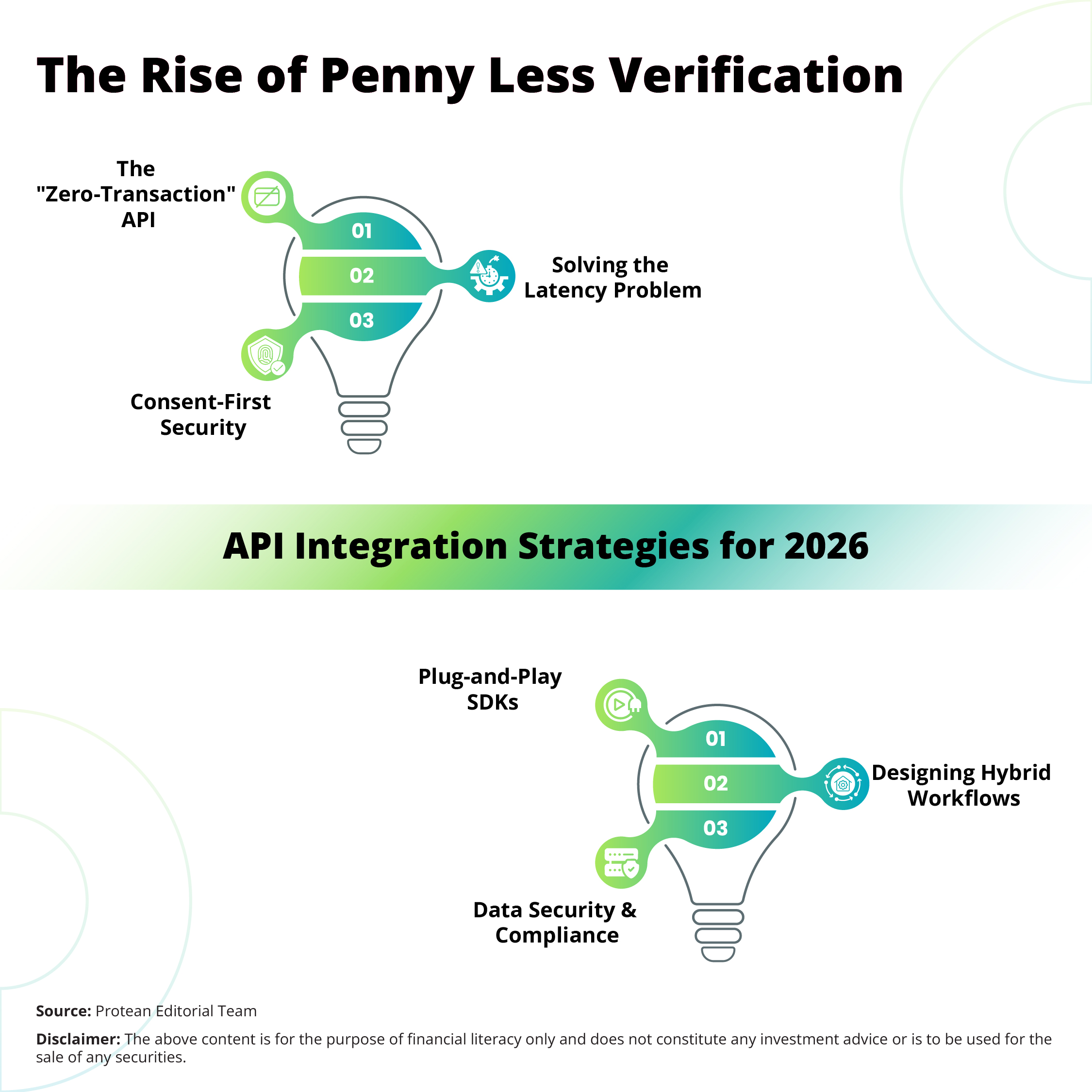
The "Zero-Transaction" API
As the name suggests, this method can verify account details without moving a single paisa. The penny less verification API queries centralised banking infrastructures. These leverage NPCI-managed systems and banking networks. They can validate the account status.
After confirming the account's existence it retrieves the registered name effectively. Thus, it mirrors the output of a penny drop API but without the financial movement.
Solving the Latency Problem
Traditional methods forced users to wait. Sometimes, they also resulted in a "Check back in 5 minutes" message if banking rails were congested.
Penny less verification solves this latency problem decisively. It utilises optimised data pipes. Thus, it moves the user from "Pending" to "Verified” in under a second."
This near-instant feedback loop keeps users engaged during the sign-up flow.
Consent-First Security
Penny less verification utilises ‘secure handshakes.’ It often validates the link between a mobile number and the bank account. Thus, privacy-first validation occurs where data is only shared with authorised entities.
It also reduces the surface area for fraud while strictly adhering to user privacy expectations.
Feasibility for Scale
Let us learn about the feasibility of penny drop verification and penny less verification.
Cost Efficiency at High Volume
Penny drop verification involves variable costs that rise linearly with your user base. However, penny less verification can operate on a lower flat-fee structure per ping.
Thus, penny less verification can offer substantial savings to a neobank or a gig-economy platform verifying thousands of vendors daily.
User Experience & Conversion Rates
Every second a user waits for a penny drop API to confirm their account is a second they have a chance of leaving the app.
Penny less verification implementation can remove this friction entirely. The seamless nature of the check feels invisible to the user. It is similar to how passport verification works in the background during identity checks.
A smoother funnel can lead to higher conversion rates and lower customer acquisition costs.
Accuracy vs. Coverage
Almost every bank account in India can receive a generic IMPS/NEFT credit. However, not all banks might support the specific data-query protocols required for penny less verification.
Thus, businesses need to assess whether their target demographic uses major banks (high coverage) or regional cooperative banks (lower coverage) before deciding.
Seamless API Integration: Implementation Strategies for 2026
Here’s how businesses can integrate penny less verification.
Plug-and-Play SDKs
Protean eGov Technologies and other providers offer plug-and-play SDKs. It simplifies this process. So, whether you are integrating passport verification for ID checks or penny less verification for bank validation, the availability of RESTful APIs and pre-built documentation allows your team to go live in days, not months.
Designing Hybrid Workflows
You can set penny less verification as the basic, low-cost check. If the ping fails or returns an inconclusive result, the system can automatically fall back to penny drop verification.
Thus, you can get the speed of the former and the reliability of the latter.
Data Security & Compliance
Your API integration needs to meet strict ISO and RBI data localisation standards.
Whether you are processing a passport verification request or a bank check, the data should be encrypted in transit and at rest. This compliance can protect you from regulatory penalties and build long-term user trust.
Conclusion: Which API is Feasible for Your Business?
Businesses can choose between penny drop verification and penny less verification based on their industry and risk appetite.
Fintechs in lending and high-value payouts can stick to the penny drop API for its proven ownership proof.
But HR platforms, marketplaces, and apps prioritising user experience can adopt penny less verification.
Frequently Asked Questions
Q1: Can I use penny less verification for NPS withdrawals?
Yes. PFRDA has mandated penny drop verification for NPS withdrawals to ensure the account is active and can receive funds.
Q2: Is penny drop verification safer than passport verification?
Now, they serve different purposes. Passport verification confirms identity, while penny drop verification confirms bank account ownership and activity.
Q3: How fast is the integration process for these APIs?
Integration time varies based on your technical setup and follows standard API documentation from providers like Protean eGov Technologies.
Q4: What happens if the penny drop transaction fails?
If penny drop verification fails, it usually indicates the account is closed, invalid, or frozen. You need to prompt the user to re-enter details or provide a different account. This is similar to how you would handle a failed passport verification.