Why should financial institutions adopt Aadhaar validation? The Aadhaar validation online technology can instantaneously process Aadhaar validation check, thereby enhancing secure customer onboarding.
The foundation of any financial institution (from large banks to agile fintechs) rests on trust and accurate identity verification.
Traditional Know Your Customer (KYC) methods were dependent on paper, manual checks, and photocopies. These introduced friction and a considerable fraction of risk.
In contrast, the digital age demands instant, iron-clad certainty about a customer’s identity. The focus has moved from “if you should digitise,” to “how.”
The Risks of Traditional Validation
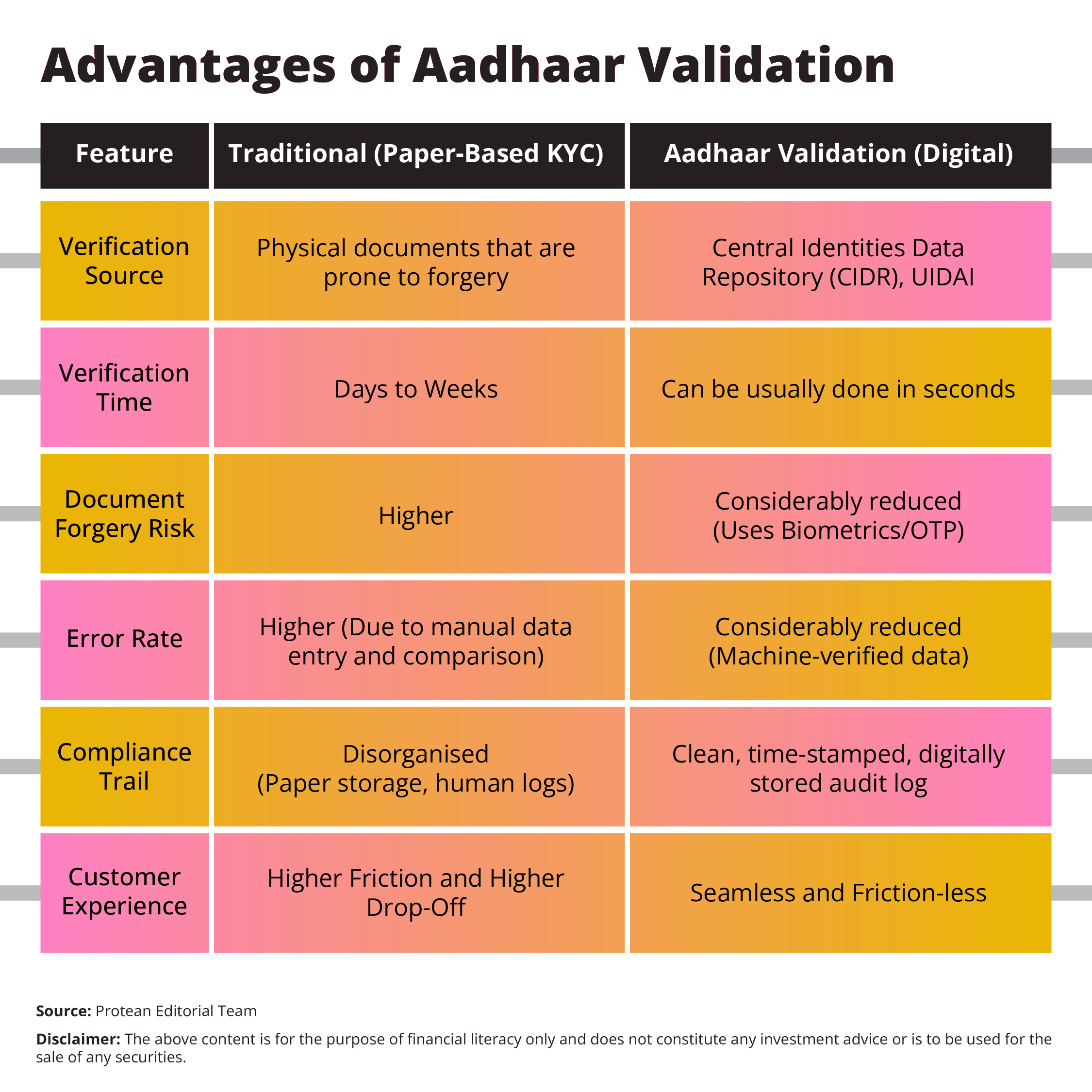
Traditional validation processes relied on the customer submitting physical documents. These included passport copies, driver’s licenses, or utility bills. They were submitted either in person or through scans.
This approach was fraught with inherent risks and inefficiencies that could make modern operations challenging.
High Exposure to Fraud
Physical documents are susceptible to forgery, tampering, and alteration. Sophisticated criminals could utilise fake IDs and alter addresses. This made manual document scrutiny highly unreliable.
Prone to Human Error
Employees had to manually verify documents, compare signatures, and input data. These manual steps could invariably introduce data entry mistakes and document matching errors.
Time and Cost Inefficiency
Usually, the process took several days to complete. They involved document movement, physical storage, and significant labor costs. This inefficiency had led to high customer drop-off rates during the crucial onboarding stage.
The Aadhaar Validation Advantage
Aadhaar validation utilises a federated, digital architecture provided by the Unique Identification Authority of India (UIDAI) to verify a resident's identity.
This process can solve the three core challenges of traditional KYC, i.e., fraud, error, and time.
The Aadhaar validation system establishes trust through cryptographic security and real-time database verification. When a financial institution performs an Aadhaar validation check, it does so through an authorised partner, Protean eGov Technologies Ltd.
Main security advantages of Aadhaar validation online include the following:
- Identity Assurance via Biometrics - The system can utilise fingerprints, iris scans, or face authentication for Aadhaar authentication. This biometric data provides an unmatched level of identity assurance, as it confirms the individual is physically present and who they claim to be, effectively preventing impersonation.
- Real-Time Database Match - Verification occurs instantly against the official, central database. The system returns a simple “Yes/No” response. This can confirm the correctness of the demographic or biometric data submitted. This process bypasses the risk of using fake or expired documents entirely.
- Auditability and Compliance - Every Aadhaar validation transaction generates a clean, time-stamped, and tamper-proof digital record. This clear audit trail demonstrates adherence to regulatory requirements (like RBI’s digital KYC guidelines), greatly simplifying compliance and enhancing audit readiness for the financial institution.
- Fraud Reduction - The Aadhaar authentication method makes it challenging to open multiple fraudulent accounts using synthetic or stolen identities, a common risk in traditional banking. The system is designed to provide a single, unique identity check.
Financial institutions, especially those utilising cutting-edge Aadhaar validation online solutions, can reduce operational costs while simultaneously fortifying their fraud defenses.
The Prerequisite for Modern Financial Services
Any financial institution aiming to scale can adopt a reliable Aadhaar validation check. This can effectively add a level of security. The speed and security of Aadhaar authentication can embed businesses with a competitive advantage in a fierce market.
Businesses can partner with authorised entities, banks and fintechs to integrate secure APIs that can process bulk verifications instantly. With this capability, businesses can instantly onboard customers, disburse loans in minutes (instead of days), and commence investment services efficiently.
The robust security framework mandates customer consent, utilises cryptographic protocols, and ensures that data privacy and regulatory compliance are built into the identity verification process from the ground up.
Conclusion
The secure, instantaneous nature of Aadhaar validation has made it a more suitable identity verification method for financial institutions.
Aadhaar authentication effectively addresses the core risks of fraud and error. It transforms a cumbersome journey into a seamless digital experience, and provides the robust audit trail demanded by regulators.
Financial institutions can migrate their KYC procedures to a streamlined Aadhaar validation check system. With this financial service providers are not just optimising operations, but can strategically future-proof their business against the growing sophistication of identity fraud.
Frequently Asked Questions
Q1: Is Aadhaar validation a secure process for customers?
Yes, it is highly secure. The system uses a consent-based model, and the UIDAI only returns a 'Yes/No' confirmation of identity, not the customer’s personal information, protecting privacy.
Q2: Can a business directly connect to the Aadhaar database?
No. Businesses must partner with authorised agencies, like a KYC User Agency (KUA), to access Aadhaar validation online services via secure APIs, ensuring compliance and data protection.
Q3: What is the difference between an Aadhaar validation check and e-KYC?
An Aadhaar validation check confirms the existence and authenticity of the number holder. Aadhaar e-KYC is a more comprehensive Aadhaar authentication process that, with consent, retrieves demographic data (like name and address) in a secure, digitally signed file.
Q4: What if a customer does not have an Aadhaar-linked mobile number?
The system supports multiple modes of Aadhaar authentication, including biometric (fingerprint or iris) scanning, which does not require a linked mobile number and is often used for in-person verification.
Q5: How does Aadhaar validation prevent document fraud?
It can considerably reduce reliance on physical documents. The system can verify the user directly against central biometric or demographic data that bypasses physical proofs, making fakes ineffective.