How can Aadhaar validation help in business efficiency? Here’s more on Aadhaar validation check as a powerful business tool.
The digital economy is embedded with the ability to instantly and securely prove a customer’s identity, as the foundation of trust. It can be slow and risky to rely on photocopies of IDs.
Thus, Aadhaar validation online supports scaling operations and managing regulatory risk for businesses operating in India. Skipping a secure Aadhaar validation check can lead to significant financial losses and compliance penalties.
It is essential to adopt an Aadhaar validation online solution to streamline your customer journey and fortify your operations against potential identity fraud.
Why Businesses Cannot Afford to Skip Aadhaar Validation
Manual verification processes involve collecting and storing physical documents. These processes are slow, expensive, and fundamentally insecure.
The modern customer demands speed and a paperless experience. So, when businesses neglect secure Aadhaar validation, they risk exposing themselves to high operational costs and considerable financial frauds.
Aadhaar validation online is efficient in solving these problems instantly. It creates a secure link to the official government identity database and ensures that your business interacts only with genuine customers.
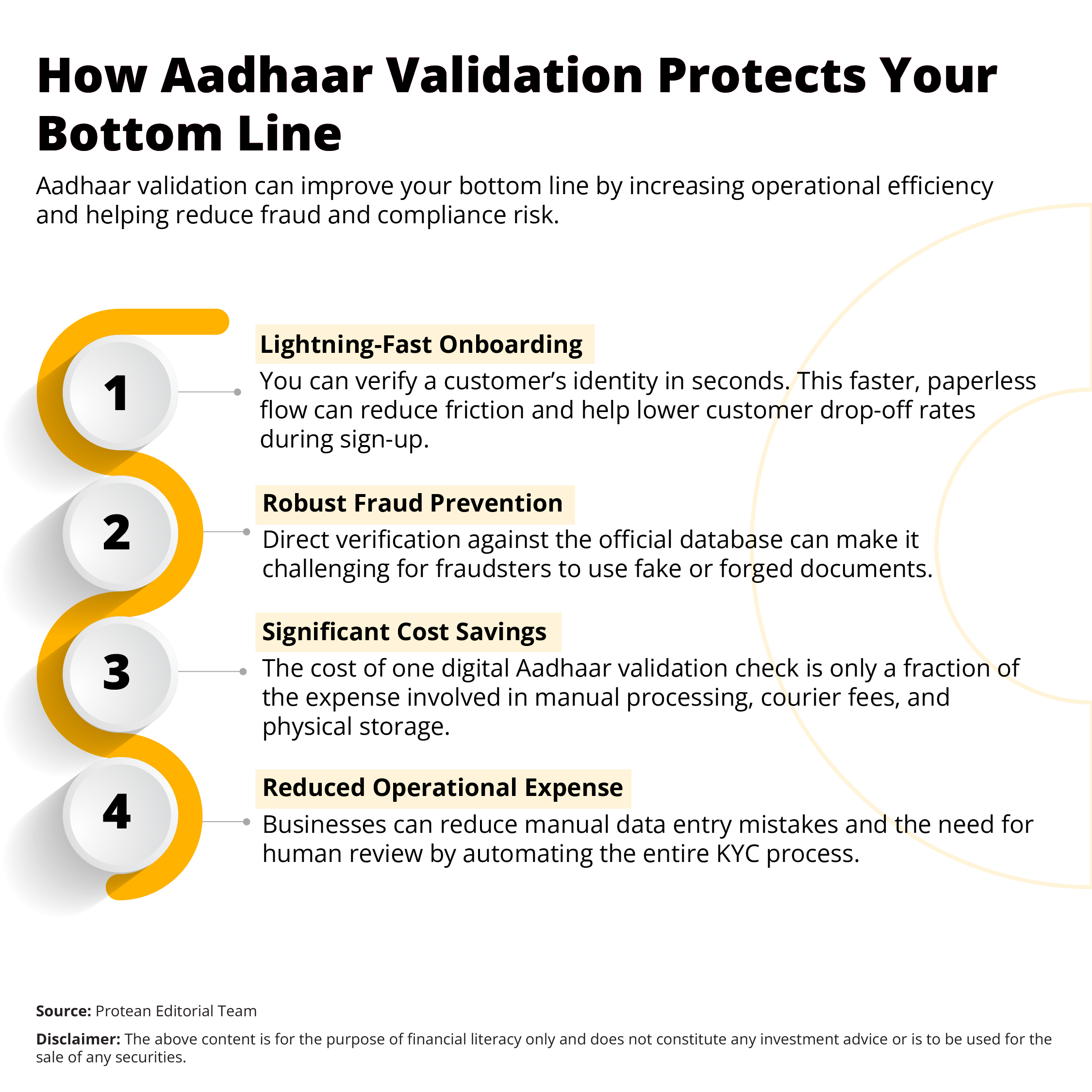
Faster customer acquisition and increased conversion rates can lead to a considerable boost in active revenue.
Fraud mitigation and reduced compliance penalties can directly result in higher profit margins and enhanced brand reputation.
Staying Audit-Ready
It’s essential for highly regulated industries like banking, fintech, and insurance to maintain a flawless, auditable KYC trail.
To seamlessly achieve this compliance, Aadhaar validation online provides the perfect tool. Every verification creates a clean, time-stamped, and tamper-proof digital record when properly implemented through an authorised partner.
This record can:
- Clearly document the customer’s explicit consent for the Aadhaar authentication
- Detail the mode of verification (whether it was OTP-based or biometric)
This digital documentation simplifies internal reviews and greatly improves the success rate of external regulatory audits.
The use of a secure, official system supports compliance and helps minimise risks of penalties under the Aadhaar Act or AML guidelines.
The Power of Aadhaar Validation APIs
Businesses cannot connect directly to the UIDAI database. They need to partner with an authorised AUA (Authentication User Agency) or KUA (KYC User Agency) such as Protean eGov Technologies Ltd.
Protean eGov technologies is a licensed entity providing secure, developer-friendly APIs that serve as the crucial bridge between your business system and the official database.
The Aadhaar validation API performs the secure authentication process.
- Consent Capture: The system records the user’s explicit consent for Aadhaar-based authentication and, for OTP-based flows, then triggers an OTP to the user’s Aadhaar-linked mobile number before proceeding.
- Data Transmission: The Aadhaar authentication request, containing the user’s Aadhaar identifier or token and the chosen verification factor (such as OTP or biometrics), is securely routed from the AUA through an Authentication Service Agency (ASA) to the Central Identities Data Repository (CIDR).
- Real-Time Match: The CIDR performs the Aadhaar authentication by matching the submitted data with the records.
- Result Return: The API returns a simple 'Yes' or 'No' confirmation to the business. In the case of e-KYC, it returns a digitally signed, machine-readable file with necessary demographic details (name, address, photo, and more), all while adhering to the principle of data minimisation.
This API model can enable rapid, plug-and-play integration with your existing onboarding flows and mobile applications. It can also ensure that your Aadhaar validation check system is scalable, capable of handling millions of transactions daily, and is built on a compliant infrastructure.
Understanding the Aadhaar Validation Check
An Aadhaar validation check is a quick, consent-based digital process that is used to verify the authenticity of the Aadhaar number holder against the UIDAI database.
The process can happen in several highly secure modes.
- OTP-based Authentication - This method can be better for remote or digital onboarding. A one-time password is sent to the registered mobile number, confirming the user is in possession of that number.
- Biometric Authentication - This method uses fingerprint or iris scans. It’s favored for high-security, in-person verification at bank branches or insurance counters.
- Offline e-KYC (XML) - The customer can download a secure, digitally signed XML file from the UIDAI, which the business can validate offline. This process respects user privacy by not requiring live database access but still provides verified demographic data.
The entire system is designed to provide immediate identity assurance while protecting the customer’s privacy.
Conclusion
The adoption of a reliable Aadhaar validation system is important to navigate the demands of the modern Indian market. This tool can eliminate fraud, reduce operational friction, and ensure seamless compliance with regulatory mandates.
Thus, your business can transform slow, risky paperwork into a lightning-fast, audit-ready digital transaction by integrating secure Aadhaar validation online services. This strategic investment is the key to building business trust and securing sustainable growth in a digital-first world.