Aadhaar verification can be the major part of India’s rural digital and financial inclusion picture. In India, the reach of identity infrastructure has already covered a huge portion of the population.
Extending seamless Aadhaar verification to rural regions can be complex due to persistent network constraints and frequent power outages. Here, traditional online authentication needs a stable, real-time connection to central servers. This could lead to session timeouts and high drop-off rates for B2B entities.
There is a high frequency of rural consumer hassles due to identity checks failing during the delivery of critical services. But there’s a robust solution through offline-first verification architectures that can bypass the need for constant connectivity.
Here’s how businesses can overcome connectivity hurdles to extend inclusive digital access for every citizen through effective Aadhaar verification protocols.
The Challenges of Online Authentication in Rural Geographies
Infrastructure and network constraints in low-connectivity zones can hamper the speed of digital transactions. Here are the three major challenges faced by rural areas.
Technical Gaps
Generally, remote geographies have lower bandwidth and higher latency. This can disrupt the connection between local devices and the central data repository. Such technical gaps could also result in incomplete transactions and consumer dissatisfaction.
Biometric Degradation
This could make it difficult for manual laborers whose fingerprints wear down through years of hard physical work. Thus, standard fingerprint-based Aadhaar verification can be less reliable in agricultural or construction hubs. So, with a scanner failing to read a thumbprint, the standard verification process halts unless alternative methods are utilised.
High Drop-Off Rates
There can be a considerable financial loss for service providers due to high drop-off rates during the KYC process. Every failed attempt can increase the operational cost and push rural customers back towards paper-based systems. This is a cycle creating a barrier to financial inclusion and limiting the reach of essential welfare schemes.
Transitioning to Offline-First Verification Architectures
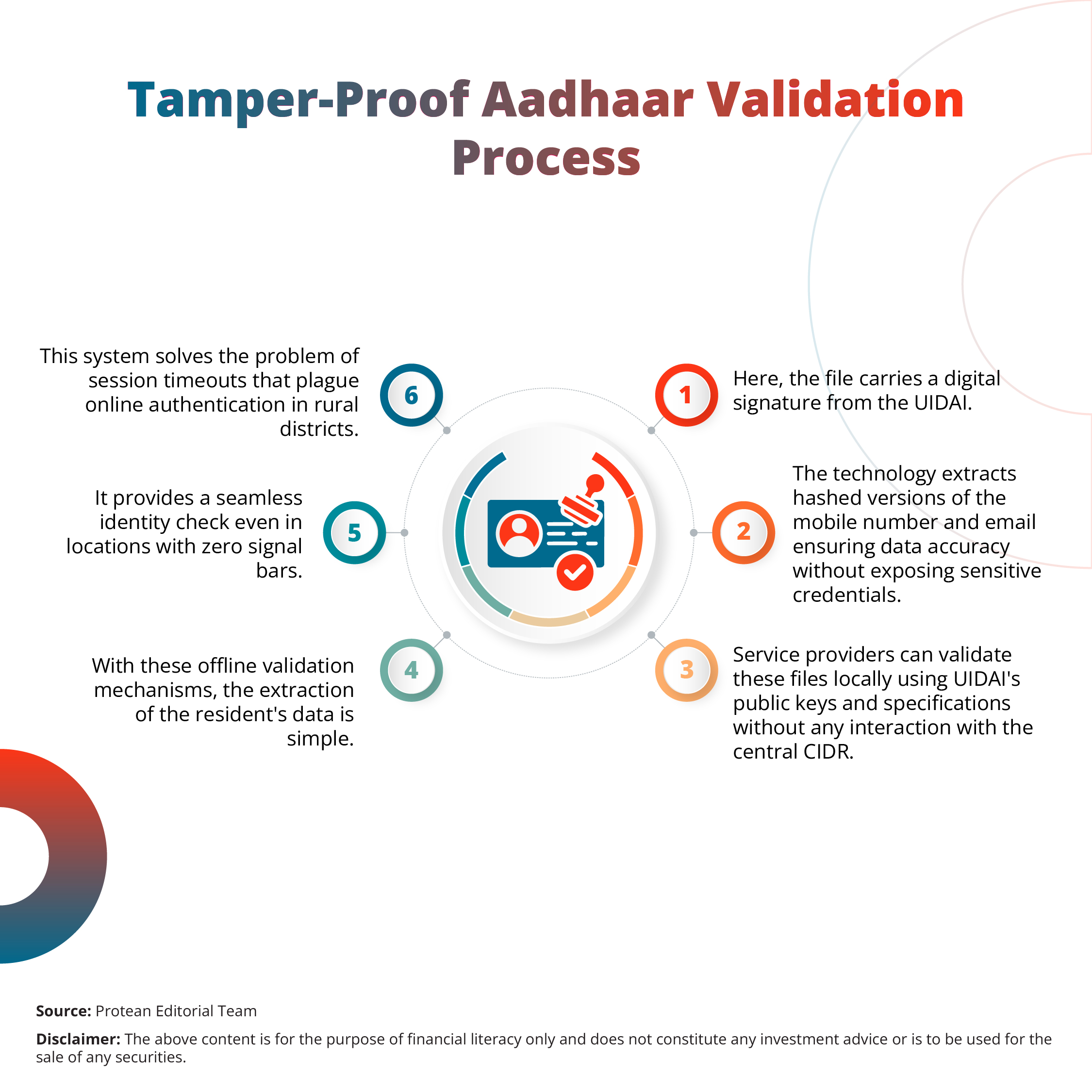
Transitioning to offline-first verification architecture can solve the connectivity dilemma. It removes the need for a live internet link during the actual identity check.
The Aadhaar Paperless Offline e-KYC mechanism is the core of this method.
- It uses a digitally signed XML file or a secure QR code.
- A user can download this secure file once and share it with service providers as needed.
- The XML file includes the resident's name, address, photo, gender, and date of birth in a machine-readable format.
Regulatory Framework for Rural Identity Security
The Digital Personal Data Protection (DPDP) Act has set the standard for how enterprises handle sensitive information.
Regulatory Compliance
Offline methods align perfectly with the Indian laws because the process avoids the transmission of the full Aadhaar number. Instead, there’s a unique reference ID comprising the last four digits of the Aadhaar number and a timestamp, to facilitate the transaction.
Consent-Based Models
Enterprises need to obtain explicit consent from the resident before initiating any form of Aadhaar validation. With this consent-driven model, transparency and trust can be retained among rural populations.
Data Encryption
Data remains encrypted throughout the lifecycle of the verification process. Privacy-by-design remains the cornerstone of the modern identity ecosystem in India. It ensures that sensitive data stays private and secure.
Building Resilient Infrastructure
Here’s how resilient the Aadhaar verification infrastructure is.
- With local storage of public keys, digital signatures on the device can be immediately validated.
- Mobile and Windows applications use offline QR code scanning in the most remote fields where no signal exists.
- Edge computing devices process verification data without any cloud reliance or server pings.
- Battery-operated biometric scanners can prevent delays during frequent and unpredictable power outages.
- Multi-modal authentication options like face matching are reliable alternatives to fingerprints for manual laborers.
- With hashed data comparison, the integrity of the information provided by the user can be maintained without data leaks.
- Automated consent logs maintain a clear and auditable trail for regulatory compliance and audits.
- Localised language interfaces improve user understanding and reduce manual entry errors during the setup.
- Compressed XML files can lead to downloads working even on legacy 2G networks or weak hotspots.
- Periodic synchronisation updates the local validation rules whenever a stable and secure connection exists.
Strategic Benefits of Aadhaar Verification for B2B Ecosystems
Here are the three main strategic benefits for B2B ecosystems.
The Removal of Real-Time Server Pings
This can drastically reduce transaction latency. Thus, agents can quickly onboard multiple customers in a single village visit. This increases business productivity and reach.
Lower Technical Overhead Cost
Operational costs can decrease because the entity no longer needs to pay for expensive dedicated leased lines or high-volume online authentication credits. The technical overhead of maintaining a constant connection can be reduced.
The Inclusivity Factor
This improves the brand reputation of the service provider. By successfully completing Aadhaar verification for a manual laborer with degraded fingerprints, such as by using face authentication, the service provider gains a loyal and satisfied customer.
Conclusion
The digital divide in India is shrinking with offline-first architectures becoming the standard for rural service delivery. Successful Aadhaar verification no longer depends on a perfect 5G signal or a consistent power grid.
Protean eGov Technologies can be a pivotal partner in this journey towards a digitally inclusive India.
Integrate offline Aadhaar verification tools today, so that no citizen remains excluded from the benefits of the digital economy.