Are you looking for an eSignature solution for your organisation? Modern institutions have moved beyond traditional paperwork towards more secure verification methods like the Digital Signature Certificate (DSC).
A digital signature certificate is a secure electronic key establishing the identity of an individual or organisation.
Considering its functions, it is a digital/virtual equivalent of a physical ID card or a handwritten signature.
Now, Government of India (GoI)-licensed Certifying Authorities (CAs), along with eSign providers like Protean eGov Technologies, support these solutions. Also, there are many entities now using a digital signature certificate to authorise high-value transactions, sign legal contracts, and file official tax returns.
Let us learn more about DSC and its role in upgrading an institution’s eSign workflows.
Why DSC is the New Institutional Standard
Traditional electronic marks offered very limited security. This was mainly because of the lack of a verified link to the actual signer’s identity. But a signature backed by a digital signature certificate can provide a much higher level of assurance for important business operations.
Licensed Certifying Authorities perform thorough background checks. They efficiently verify the credentials of an institution before they ever issue a digital signature certificate. With this verification process, every DSC-based carries the full weight of legal authority.
Institutions often prefer DSC for high-assurance needs to meet specific compliance mandates and protect sensitive corporate data. With this transition, there has emerged a standardised way for third parties to verify a signature without the need for physical presence.
What Changes for the End User?
Now, digital signature certificate users can experience a much more streamlined and secure process for interacting with modern financial or legal platforms.
Institutions can utilise a digital signature certificate to let customers sign documents with total confidence from any remote location. The modern workflow can include a mandatory multi-factor authentication step to trigger the use of the stored digital signature certificate. This extra layer of security is designed to prevent unauthorised parties from accessing the e Signature capability.
Every completed document displays specific visual and technical indicators. These indicators prove to the recipient that the file has not undergone any alteration since the user applied the eSign. Thus, the user can feel safe while they handle sensitive agreements online.
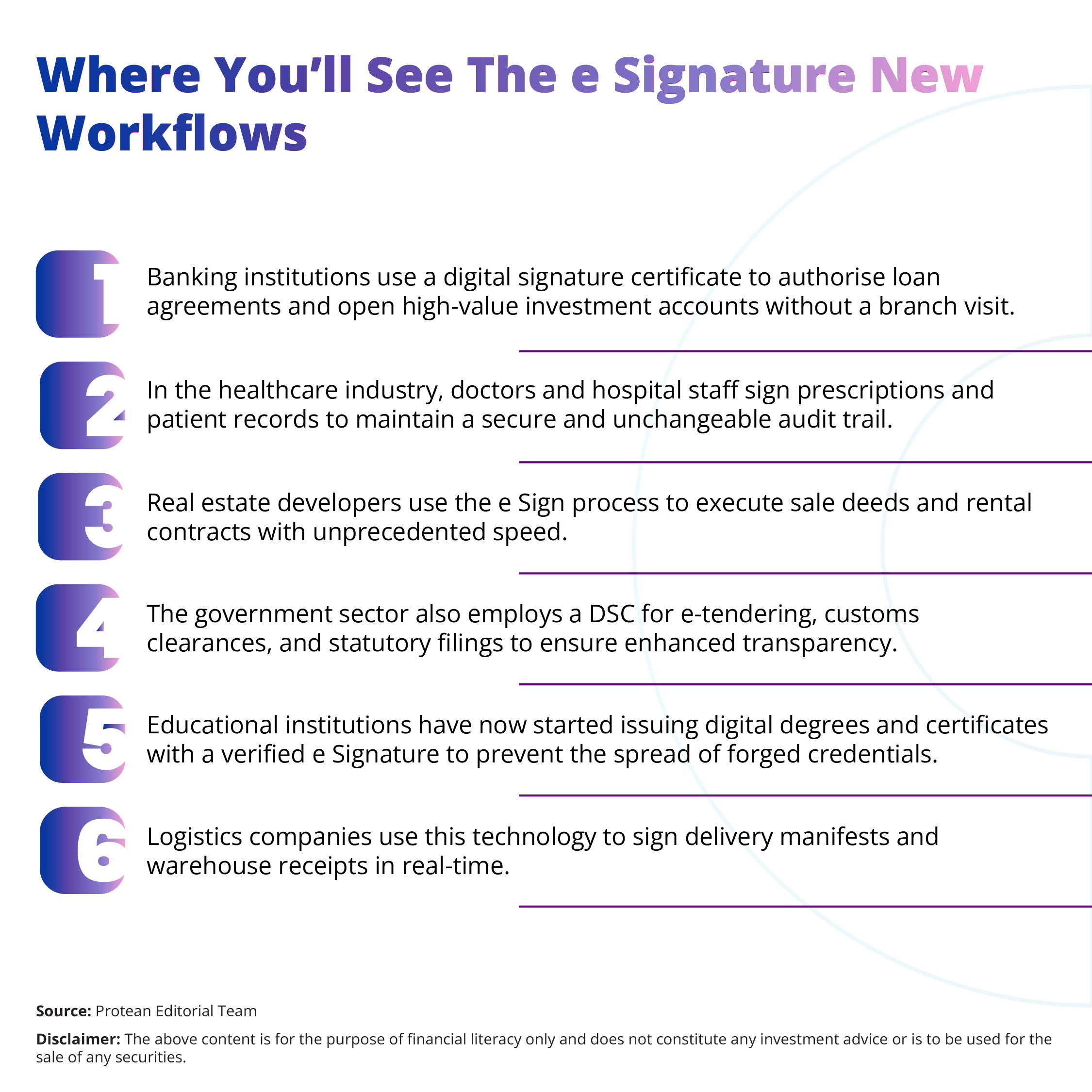
Where You’ll See These New Workflows
The advanced eSignature workflows are adopted by various sectors to replace slow and expensive physical paperwork.
Security Benefits of a Digital Signature Certificate
With a digital signature certificate, only the authorised owner of the key can sign documents. Advanced cryptographic technology can protect every eSign so that no malicious (fraudulent) party can replicate or forge the signature.
This high level of security adds the benefit of non-repudiation. Meaning, a signer cannot deny their signature in a court of law later. Documents featuring an eSignature can remain valid and verifiable for decades due to standardised Long-Term Validation (LTV) protocols.
Organisations can prioritise these security benefits to build a solid foundation of trust with their global clients. With this encryption process, the identity of the signer is bound to the data in a way that makes tampering immediately visible.
Transitioning Your Institution Successfully
A successful transition to an automated and paperless workflow requires the selection of a reliable API provider. Institutions must focus on user education to help their customers understand the importance of a secure digital signature certificate. Scalability remains a key factor because the volume of digital transactions grows significantly every year. A robust e Signature system should handle thousands of concurrent requests without any loss in performance or security.
Proper planning and the use of a DSC from a trusted authority ensure a smooth implementation process for all stakeholders. Modernising the verification stack allows institutions to grow their operations without the limitations of traditional document handling and storage. Regular audits and updates to the signature workflow keep the institution ahead of potential cyber threats. Digital transformation starts with a commitment to reliable and verifiable identity standards.
Conclusion
With a digital signature certificate, you can feel secure about the authenticity of all parties involved in a high-stakes digital transaction.
As more essential services move to the cloud, the use of a secure e Sign becomes the standard expectation for every consumer. Institutions embracing this shift can gain a significant advantage in efficiency and trust. You can consider the many advantages of a verified eSignature for your business operations today. Secure your digital future with a trusted digital signature certificate.
Frequently Asked Questions (FAQs)
Q1: How does a digital signature certificate differ from a regular eSign?
A digital signature certificate uses asymmetric cryptography and is issued by a licensed authority after identity verification. A simple eSign might just consist of an image of a signature, whereas a DSC provides legal non-repudiation and technical proof of identity.
Q2: Is an eSignature legally valid for all types of business contracts?
The Information Technology Act recognises an eSignature as legally equivalent to a handwritten signature for most commercial purposes. It carries significant weight in legal proceedings when backed by a valid digital signature certificate and a secure audit trail.
Q3: What happens to a document if my digital signature certificate expires?
An expired digital signature certificate does not invalidate signatures that were applied while the certificate was still active. However, you need to renew the DSC to continue with new secure eSign operations and maintain regulatory compliance for future documents.