Digital transformation in India has rapidly moved beyond paperless signatures. Today, even stamp duty payment is carried out electronically.
The introduction of e stamp (electronic stamp duty) has brought speed, accuracy, enhanced security, fraud prevention, and regulatory compliance to the documentation lifecycle.
For businesses dealing with recurring contracts, onboarding documents, leases, loan agreements and vendor management, e stamping has emerged as a smarter, safer and more efficient alternative to traditional stamp procurement.
What Is an e stamp and How Does It Work?
An e stamp is a digitally generated certificate confirming that the required stamp duty for a legal agreement has been paid to the government, replacing traditional stamp papers and reducing risks like fake stamps, back-dating and supply shortages.
It is issued through authorised service providers and centralised platforms. It includes a unique identification number (UIN), transaction details, payer information, stamp amount and date, making it instantly verifiable.
The issuance process is as follows:
- The user selects the jurisdiction and value of stamp duty applicable.
- Payment is completed online via authorised channels.
- The system generates a digital stamp certificate with a UIN that can be validated anytime by authorities or stakeholders.
Once generated, the e stamp certificate can be:
- Attached to a digital agreement
- Embedded within a PDF
- Printed, or used alongside e-signature (for remote, legally valid execution)
With most states progressively shifting to electronic stamping mechanisms, organisations now enjoy fast, round-the-clock access rather than relying on agents, physical stock availability or franking counters.
Role of e Stamping in Contract Streamlining
The shift to e stamp has significantly reduced administrative effort in managing commercial and legal agreements. Traditionally, organisations dealt with delays due to the unavailability of stamp papers, risk of defective/franked copies, and the operational burden of physical handling and storage. e stamping removes these bottlenecks and brings predictability to contract workflows.
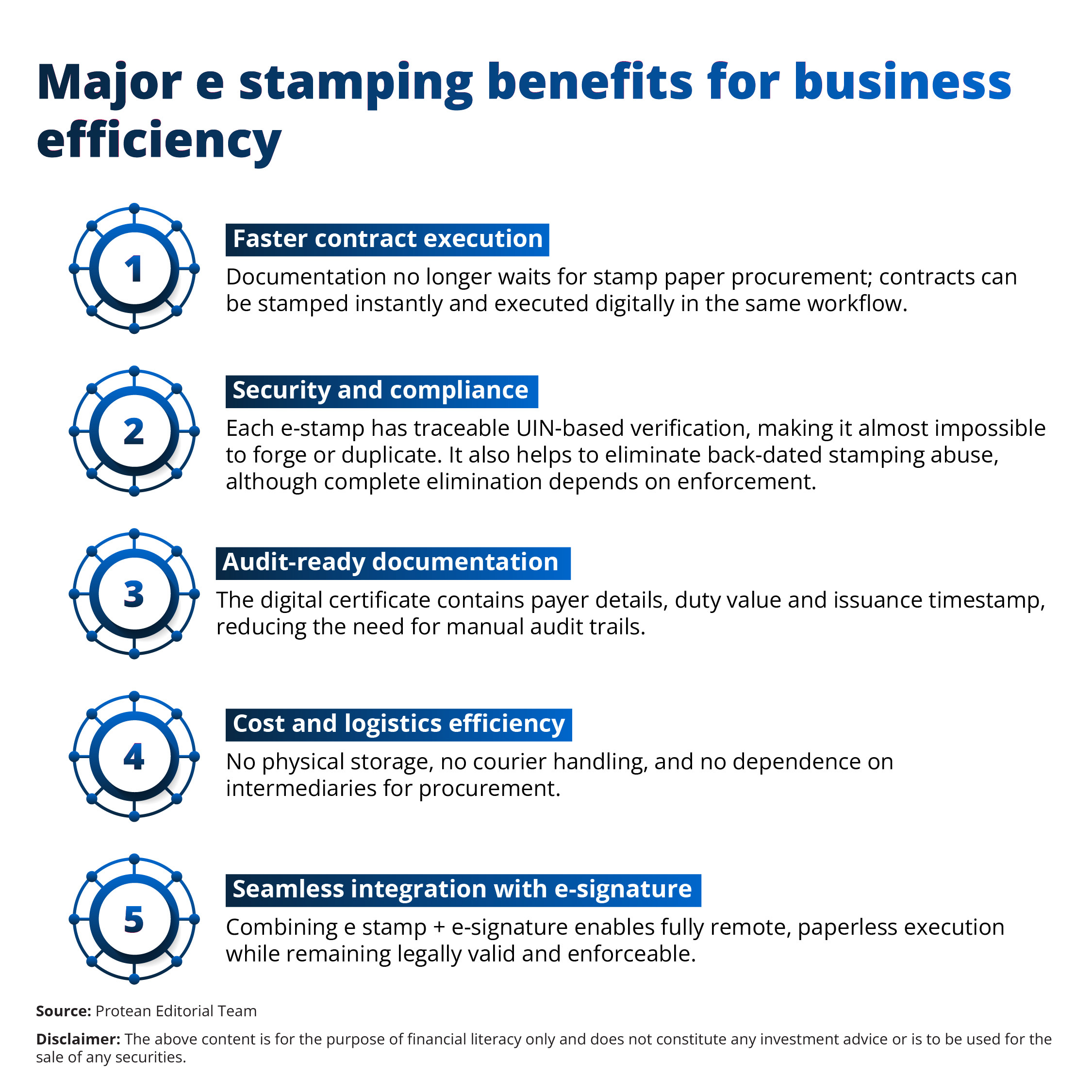
For businesses processing high contract volumes such as banks, Non Banking Financial Companies, insurance providers, real-estate companies, Fintech Companies and HR consulting firms, this integrated model drastically reduces turnaround time. Instead of days spent on stamping and signing cycles, agreements can now be executed and archived in just minutes.
Where to Use e stamps in Legal Agreements
e stamping applies to most agreements where stamp duty is mandatory under state-specific laws. Some of the most common use cases include:
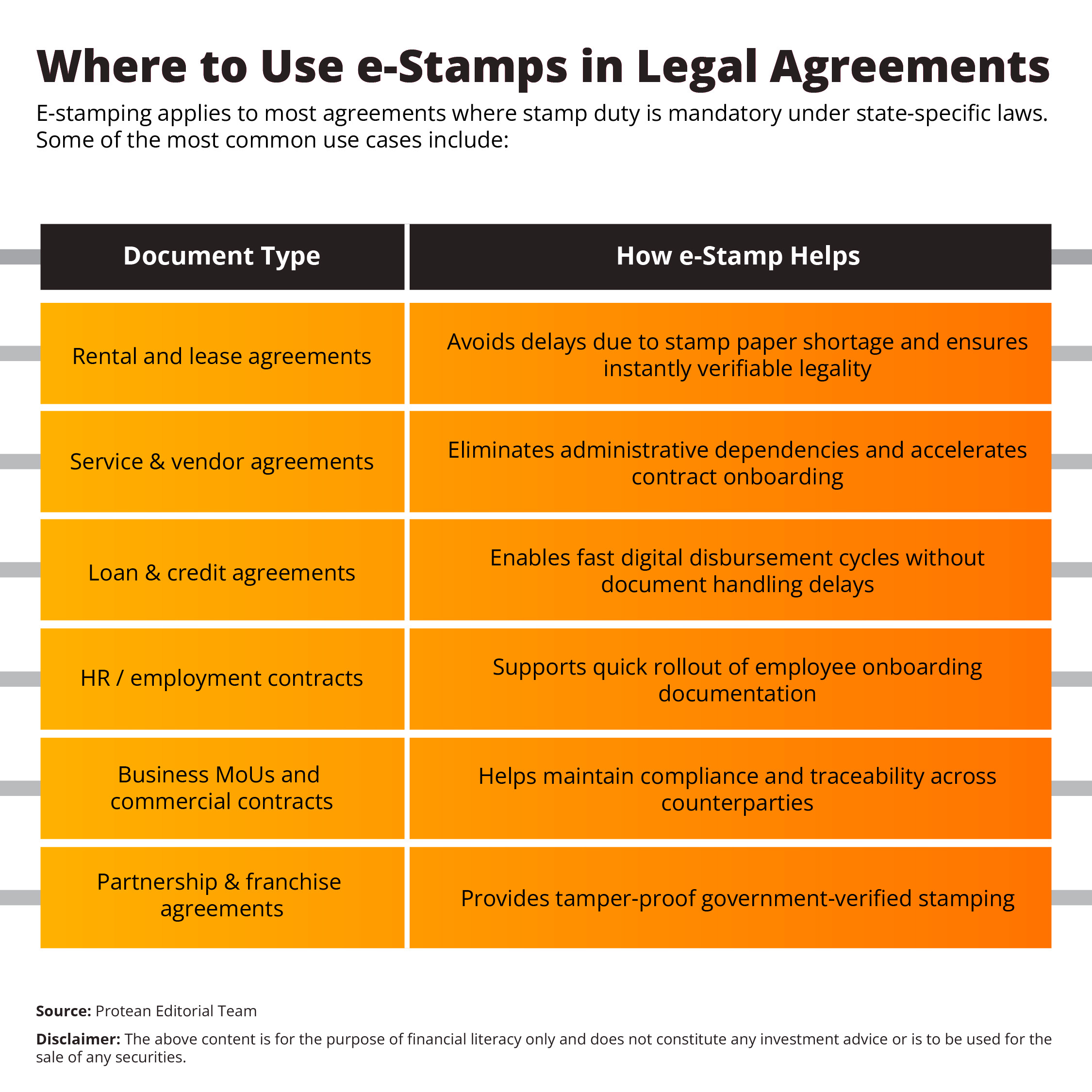
In each of the above scenarios, pairing e stamp with digital signatures and secure online validation creates an end-to-end digital contracting stack that satisfies both legal and regulatory requirements while improving efficiency.
Conclusion
E stamp usage has moved beyond convenience. It has become a compliance-friendly operational necessity for organisations seeking faster and more secure contract execution. It minimises fraud, removes physical dependency, and integrates seamlessly with digital signatures to create a fully enforceable, paperless documentation journey. With its rising popularity among government offices and agencies adopting and expanding e stamping frameworks, the future of legal and commercial contracting in India is set to become faster, safer, and increasingly digital.
Frequently Asked Questions
Q1: Is e stamp legally valid?
Yes. Using an e stamp is fully legal and recognised as official proof of stamp duty payment under authorised state and/or UT frameworks.
Q2: Can e stamp replace physical stamp papers?
Yes. An e stamp can serve the same legal purpose as traditional stamp paper and is often more secure and traceable.
Q3: Is e stamp mandatory for digital agreements?
Yes, wherever stamp duty applies under state law, it must be paid for the agreement to be legally enforceable. Payment can be made digitally via e stamp or through physical means, depending on state regulations.
Q4: Can an e stamp be reused or transferred?
No. An e stamp is generally generated for a specific document and is not transferable. However, improper usage or lack of tracking in some cases has led to reuse risks.
Q5: Can e stamp and e signature be used together?
Absolutely yes. You can combine e stamp with e signature. With this, you can enable legally valid, fully digital contract execution without physical paperwork.