Onboarding processes can become seamless by using eKYC API systems. But did you know that an eKYC API integration can also reduce business expenses?
Manual onboarding can present hidden financial challenges for any booming enterprise. Each manual verification step can raise the per customer cost. Also, any delay in the verification process can increase the potential of a drop-off.
Generally, businesses struggle with the transition from fragmented verification steps to a unified API integration strategy. With such shifts, businesses can move towards efficiency and higher conversion. Thus, an integrated eKYC API can be the engine for this modern transformation. Institutions no longer view digital verification as a mere luxury.
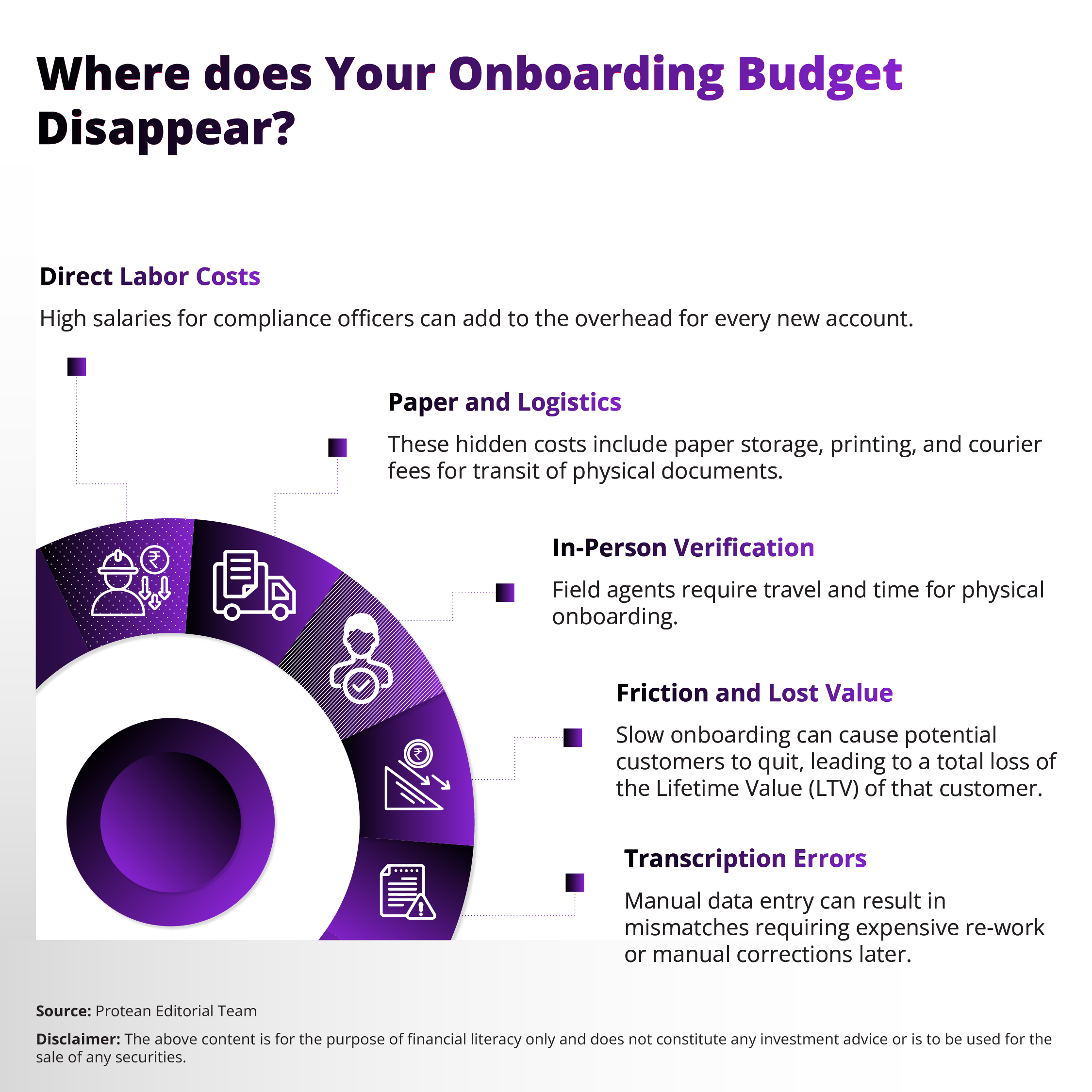
Where does Your Onboarding Budget Disappear?
There is a cumulative cost to manual labour that financial institutions might underestimate. Here is how traditional onboarding practices can impact your onboarding budget.
How to Reduce Expenses with eKYC API Integration
With digital transformation, businesses can drastically reduce operational expenses. A single eKYC API call can replace days of manual labor with significantly quicker response times. Here is how eKYC API integration can reduce onboarding expenses of a business.
- Unified DPI Stack - A single API integration with India’s Digital Public Infrastructure (DPI) can effectively replace multiple vendor contracts. Such a consolidation can simplify the billing and technical architecture.
- Real-Time Validations - The eKYC API can fetch demographic details directly from government databases. Thus, the data accuracy can be increased and the need for manual cross-checks can be minimised.
- ML-Driven Fraud Filtering - Modern APIs use machine learning to instantly detect anomalies. The eKYC API system can filter out fraudulent attempts without a human investigation for every minor "flag."
- Elimination of Paperwork - Digital verification can minimise the need for physical storage facilities and shredding services.
- Lower Transaction Fees - The marginal cost of a digital check is comparatively much lower than a physical verification visit.
Thus, an eKYC API can be reliable for high-stakes financial decisions. It can create a seamless flow from the initial click to the final approval.
Strategic Scalability: From 10 to 10,000 Customers Daily
One of the main concerns of fintech companies and digital lenders is scalability. An onboarding flow requiring no human intervention for a majority of users can offer a clear competitive edge.
Furthermore, the infrastructure handling peak festive season can load as easily as standard daily traffic.
- Integrated APIs can connect to various government databases, such as UIDAI or the Income Tax department. They can connect them through a single entry point.
- Due to its architectural simplicity, a startup can behave like a large enterprise from day one.
- The eKYC API can manage the load balance and ensure high uptime for the application.
Therefore, companies can avoid the technical debt of building custom connectors for every new government database.
Compliance as a Cost-Saver, Not a Burden
Regulatory compliance can feel like an expensive burden for the operations team. Here’s how an eKYC API can transform compliance into a cost-saving mechanism.
- Automated Audit Logs - The eKYC system can generate tamper-proof logs for every transaction, reducing audit timelines considerably.
- Managed Backend Updates - API providers like Protean eGov Technologies can update their infrastructure for new laws, such as the Digital Personal Data Protection (DPDP) Act. This ensures the internal development team does not waste months on compliance-related code changes.
- Risk Avoidance - Verified, government-backed data sources can prevent the business from penalties linked to faulty KYC actions.
- Identity Assurance - A person’s identity can be confirmed through instant checks, verifying whether the person on the other side of the screen is who they claim to be.
- Consistent Reporting - Digital systems can provide standardised data, making internal reporting effortless.
Thus, businesses can protect their reputation by using a secure eKYC API for customer identification.
Conclusion: Final Recommendation
Integrated eKYC can be an important survival requirement for competitive firms in the Indian market. A shift to a strong eKYC API infrastructure can reduce operational costs by a huge margin. This technology can empower the compliance team to focus on high-risk cases while the automated system handles the standard users.
Protean eGov Technologies can offer the tools necessary for this transformation. Implement an eKYC API now to secure your growth and protect your bottom line.
Frequently Asked Questions (FAQs)
Q1: How does an eKYC API lower the cost of a single customer onboarding?
The API can minimise manual labor, document printing, and physical storage needs. This reduces the per-customer verification cost considerably by reducing the need for manual intervention.
Q2: Can a small startup use the same API integration as a large bank?
Yes. The infrastructure is designed to be inclusive. Startups access the same government-regulated databases through a single eKYC API to compete with larger players.
Q3: Is the data retrieved through an eKYC API legally valid?
The data comes directly from UIDAI or other government sources. This makes the information more reliable and legally sound than physical photocopies of identity cards.
Q4: How long does the API integration process take for a new business?
Modern platforms provide SDKs and documentation that allow developers to complete the API integration in a very short period (generally, to just a few days). This can considerably reduce the go-to-market time for new products.