Why should GST online verification be treated as a business imperative, rather than an optional step? Businesses that engage with GST‑registered vendors, distributors, service providers, contractors, or freelancers routinely pay GST as part of their invoicing processes, where the underlying supplies are taxable. However, it is often assumed that GST charged on an invoice is automatically valid, compliant, and eligible for Input Tax Credit (ITC).
In practice, invoice and GST data issues are more frequent than most organisations anticipate, arising not only from malpractice but also from oversight, cancelled or suspended GST registrations, and non‑filing or delayed filing of statutory returns.
It is of vital importance to avoid the risk of financial loss through excess tax payment or denial of ITC. GST online verification has evolved from a best practice into a critical safeguard for ensuring compliance and preventing avoidable business exposure.
The Core Non-Negotiable Risks
When you approve an invoice without verifying GST details, you expose your organisation to risks that may surface months or years later. Each risk can translate into direct financial loss or increased tax scrutiny and litigation pressure.
Some of the most concerning risks include:
Overcharging due to invalid or inactive GSTIN
A vendor could charge GST despite a cancelled or inactive GST registration, leading you to pay taxes that should never have been levied.
Loss of Input Tax Credit (ITC)
Even if you pay GST correctly, your ITC may be disputed later if the vendor fails to deposit GST or does not file returns, and authorities may challenge your claim unless they are satisfied about your due diligence and the genuineness of the transaction.
Mismatch between business details and GST registration
If the GSTIN on the invoice belongs to a different legal entity or a different state, the invoice becomes non-compliant.
GST charged at incorrect rates
Vendors sometimes use higher tax slabs than applicable for the supplied goods or services, leading to excess payments.
Compliance scrutiny and audit flags
Repeated dealings with high‑risk or non‑compliant vendors can increase the likelihood of deeper audits, enquiries, and notices for your business.
The major practical risk often does not lie in the GST framework itself, but in approving payments without verifying vendor GST credentials and invoice compliance at the source. Once payment is processed, reversal becomes difficult, ITC becomes uncertain, and audit defence becomes complicated. This is why online systematic GST verification is important.
Why Manual Verification Fails at Scale
Manual verification on the GST portal is feasible for limited vendor interactions, but becomes impractical and risk-prone as business scale, vendor volume, and transaction frequency increase.
Some of the most common limitations include the following.
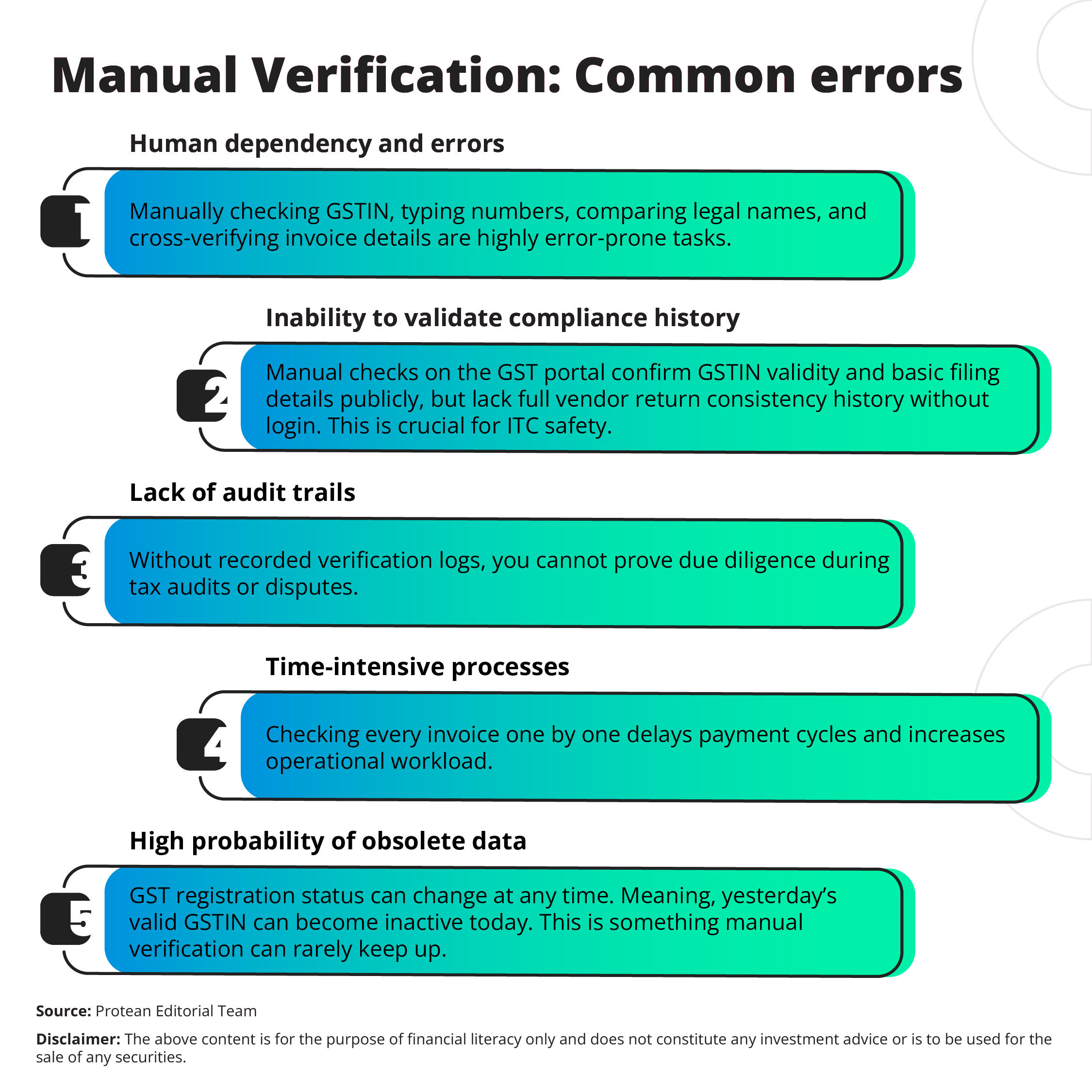
When invoice volumes rise or vendor count expands, manual verification becomes unscalable, inconsistent, and financially risky. Compliance cannot rely on memory, goodwill, or paperwork as it requires automation.
The Automated Solution: Making Verification Seamless
Automated GST online verification provides the speed, accuracy, and audit-readiness that modern businesses need. Using API-driven verification, you can do the following:
- Verify GSTIN validity, status, and registration type in real time
- Confirm that the legal name and business entity match the invoice
- Check whether the registration is authorised for the state and industry category
- Track periodic return-filing patterns to identify compliance-risk vendors
- Create a structured audit trail for every invoice or vendor onboarding cycle
What makes automation truly effective is that it can be integrated into your existing systems, vendor onboarding tools, invoice processing platforms, ERP systems, and payable workflows. Once integrated, verification runs as a background process, without adding extra manual steps for your team. Finance teams receive alerts only when inconsistencies arise, ensuring faster payments for compliant vendors and stronger filters for high-risk ones.
You do not just verify compliance, you embed it into business operations, reducing the likelihood of losses instead of reacting only after issues arise.
Conclusion
Today’s business environment demands more than invoice settlement. With regulatory expectations rising and ITC eligibility becoming more dependent on vendor compliance, GST online verification is a strategic defence rather than a procedural step. Whether you work with 20 vendors or 20,000 vendors, the cost of not verifying GST details will always outweigh the cost of implementing automated verification.
Businesses can gain by choosing an API-driven approach. They can protect their business from overcharging, safeguard ITC, support timely audits, and build an ecosystem of reliable suppliers and contractors.
Frequently Asked Questions
Q1: What is the difference between an inactive GSTIN and an invalid one?
An inactive GSTIN is a previously registered GST number that has been cancelled or suspended, while an invalid GSTIN is a number that was never issued by tax authorities.
Q2: How often should a business run GST online verification on vendors?
You should verify GSTIN during vendor onboarding and again while processing invoices. This especially applies for high-value or high-risk vendors whose compliance status may change over time.
Q3: Is manual GST online verification sufficient for a business?
Manual verification may work for a small vendor base, but automated API-driven verification is essential for accuracy, scalability, audit readiness, and financial protection.