There are several benefits associated with online signature validation. Signature validation tools have strengthened the digital signature ecosystem for secure business processes.
In today’s digital environment, signing a document isn’t enough; its validity must remain provable even after it is shared or archived. When a signing certificate expires or many years have passed, it becomes critical to prove that the signature was valid at the time of signing and that the document has not been altered since.
A trusted timestamp helps address this by binding the signature to an exact moment in time, supporting its evidentiary and legal value even after certificate expiry or long‑term storage, especially when used with proper long‑term validation data.
Let us learn how timestamps can strengthen signature validation online and why they are essential for long‑term trust:
The Digital Signature Lifespan
A cryptographic key pair and a certificate issued by a licensed Certifying Authority (CA) are used to create a digital signature. Such a digital signature is legally recognised in India under the Information Technology Act, 2000. However, every signing certificate has a limited validity period, and once it expires, it may become difficult to prove later that the certificate was valid at the time of signing and that the document remained unchanged.
A trusted timestamp helps address this by recording the attested signing time, making long‑term signature validation simpler and more reliable, as also described in guidance from the Controller of Certifying Authorities (CCA).
The Long-term Validity
Why does a timestamp matter for long-term validity? Here are the main reasons:
Proof the signature was affixed while the certificate was valid
A timestamp from a trusted Time Stamp Authority (TSA) captures the moment of signing. Even if the certificate later expires or is revoked, the timestamp shows when the signature event occurred, so validators can confirm that this time falls within the certificate’s valid and non‑revoked period.
Document integrity over time
If a document is challenged years later, a timestamp ensures that the signed content existed at that moment and links it to the signing event. Standards such as the ANSI ASC X9.95 Standard for trusted timestamps provide mechanisms to prove authenticity, timeliness and integrity.
Legal admissibility in India
Under the IT Act and associated rules, electronic signatures that satisfy prescribed standards are afforded the same legal effect as handwritten signatures.
Courts typically consider whether the signature creation data, document integrity, and link to the signatory have been maintained, in line with the secure electronic signature requirements under the IT Act. A trusted timestamp strengthens this by establishing the time link.
Audit-trail and archival readiness
For organisations with compliance requirements (e.g., financial services, filings, government contracts) being able to show that a document was validly signed and time-anchored is essential. A properly embedded timestamp is part of that audit trail.
Certificate expiry / revocation mitigation
Even if a certificate is revoked after signing, if a trusted timestamp exists showing the signing happened before revocation, the signature validity can still be demonstrated. This is especially valuable for high-value contracts or long-term retention documents.
How to Perform Signature Validation Online
When validating a digitally signed document online, particularly one containing a timestamp, the following steps should be followed:
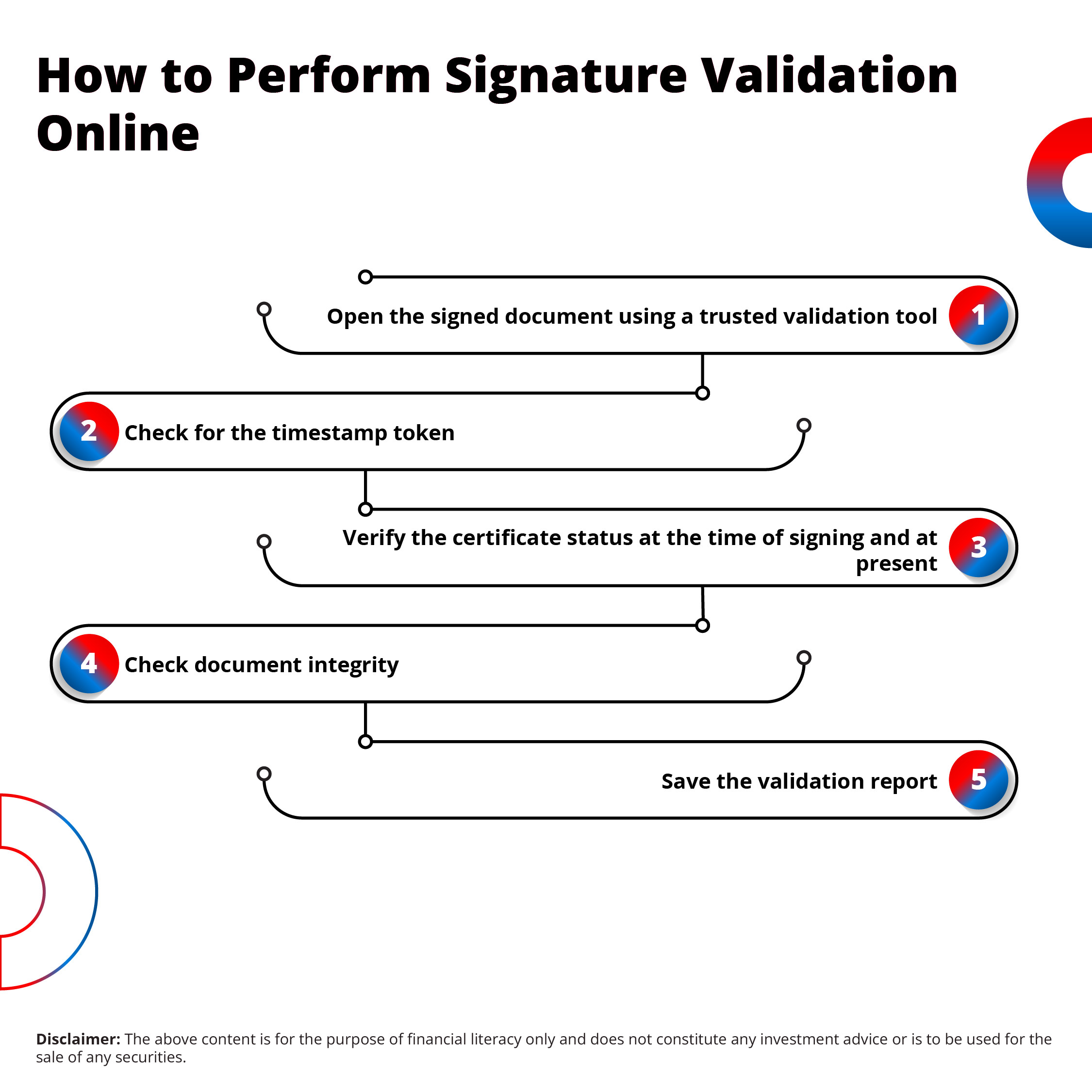
Open the signed document using a trusted validation tool
For PDFs, use Adobe Reader/Acrobat’s Validate Signature feature. It will indicate whether the signature is valid, whether the certificate chain is trusted, and whether a recognised timestamp is present.
Check for the timestamp token
In the signature panel, look for a timestamp or “time-stamped signature” label. Ensure that the timestamp was issued by a recognised Time Stamp Authority (TSA) and that the signing time is clearly displayed.
Verify the certificate status at the time of signing and at present
The validation tool should confirm that the certificate chain links to a licensed root Certifying Authority (as per the IT Act) and that the signer’s certificate was valid at the time of signing. Even if the certificate has since expired, the timestamp will confirm it was valid at the moment of signing.
Check document integrity
The tool will notify you if any part of the document has been changed after signing. A trusted timestamp binds the document’s hash to the signing event, and any modification will automatically break this link.
Save the validation report
After successful validation of both the signature and timestamp, save the validation report containing details such as the status, timestamp, and certificate information. This report serves as an essential audit record and supports legal admissibility in case of future disputes.
Conclusion
Timestamps are a crucial extension of digital signatures. A digital signature builds trust at the moment of signing, and a trusted timestamp helps preserve that trust long after, including when certificates later expire or documents are reviewed years later, provided the timestamp and validation data remain valid.
To keep digitally signed documents more legally defensible over time, trusted time-stamping should be part of the signing process, alongside other long-term validation measures. It is not only about validating the signature today, but about ensuring it can still be validated in the future using embedded timestamps and long-term validation data.
Frequently Asked Questions
Q1: What is “signature validation online”?
It means checking a digital signature online to confirm the signer, timestamp, and document integrity so you know it has not been altered.
Q2: Can a signature still be valid if the certificate has expired?
A: Yes, if a trusted timestamp can prove that the signature was created before expiry, the signature would remain valid and legally defensible.
Q3: Who issues the timestamp?
A: A trusted Time Stamp Authority (TSA) issues the timestamp at the moment of signing to record the exact time.
Q4: Are timestamps mandatory in India for legal validity?
A: It is not always mandatory, but highly recommended because they strengthen legal proof and compliance during audits or disputes.
Q5: How long should I retain timestamped signed documents?
A: Retain them as per your organisation’s and regulatory requirements, since timestamping helps maintain long-term legal validity.