As global citizens, passport verification stands as one of the most authentic identity verification methods. However, manual verification is the main hurdle for modern B2B scaling efforts.
Businesses that rely on human efforts to validate documents can face delays and high operational costs.
A passport verification API effectively bridges the gap between legacy security protocols and a modern user experience. Passport number verification technology can shift from error-prone manual OCR (Optical Character Recognition) to real-time database pings and biometric cross-referencing.
Thus, a passport verification API can result in a frictionless onboarding journey that maintains the highest security standards.
Why Enterprises Prioritise Passport Number Verification
Enterprises across the globe prioritise passport number verification to protect themselves from the rise of sophisticated financial crimes.
It is easy for false identities and doctored documents to pass visual inspections. But with passport verification API integration, they are more likely to fail. This API can detect anomalies in the MRZ (Machine-Readable Zone). They can also flag inconsistencies that human eyes might miss.
Furthermore, regulations such as AML (Anti-Money Laundering) and KYC (Know Your Customer) require thorough identity proofing. Businesses need to strictly comply with the global compliance frameworks.
Businesses must also comply with GDPR (General Data Protection Regulation) and CCPA (Central Consumer Protection Authority). These compliances require companies to handle identity data with extreme care.
Another important aspect is operational efficiency. A manual passport verification process can take up to 48 hours or more. This can lead to high customer drop-off rates. But a digital verification system can complete this task within a few seconds.
With such a quick response the legitimate users can move through the sales funnel without frustration. Companies implementing passport number verification can witness considerable improvement in conversion rates.
Thus, with the passport verification API businesses can scale operations without a proportional increase in headcount or overhead.
Technical Architecture: Assessing Your Current Stack
Businesses need to thoroughly assess their existing technology stack to successfully deploy passport verification API.
Legacy systems might need a different approach to maintain connectivity. Middlewares or "wrapper" services allow older ERP (Enterprise Resource Planning) tools or CRM (Customer Relationship Management) platforms to communicate with modern verification API technology.
With these wrappers the legacy data formats translate into the required API structure.
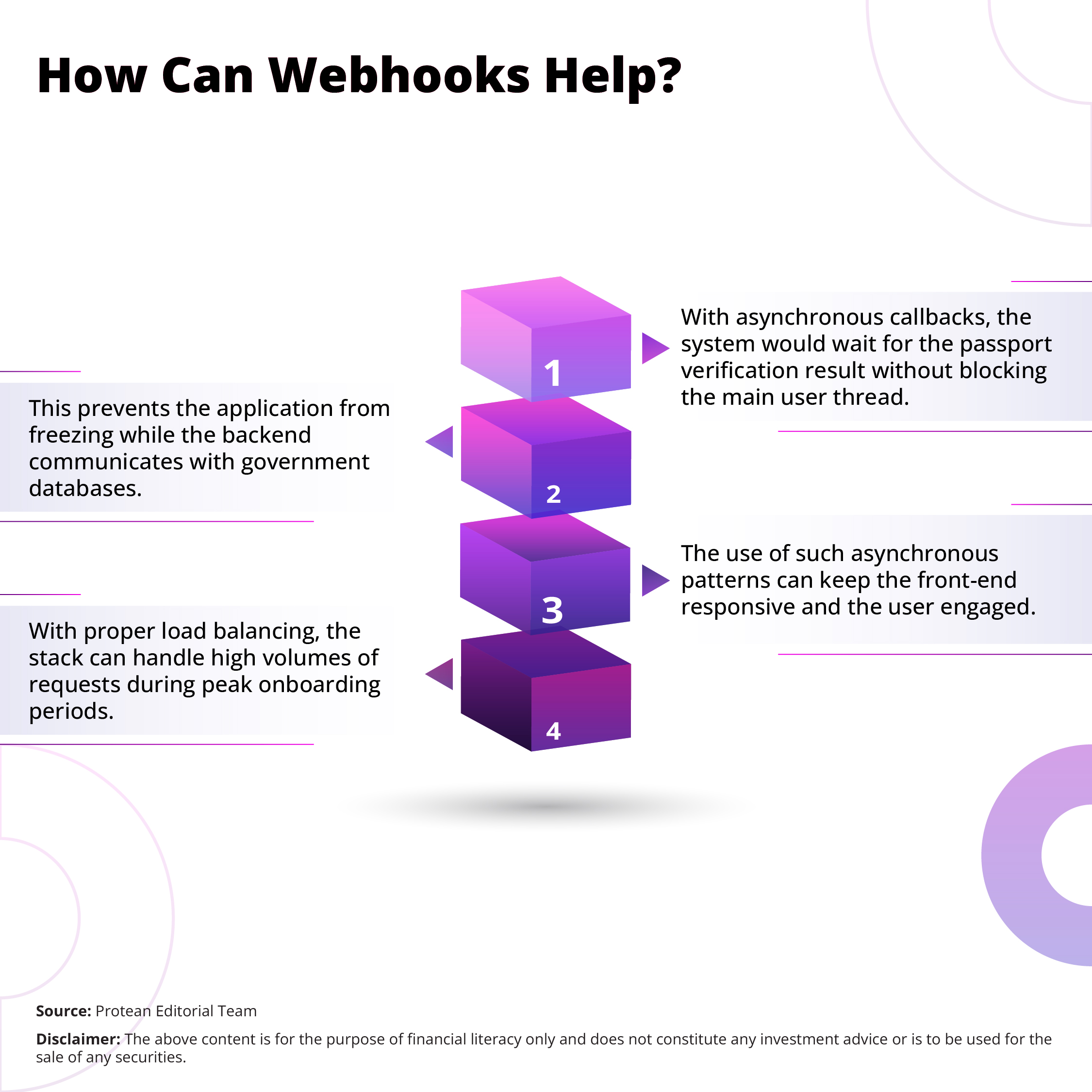
Webhooks play an important role in many architectures" to avoid overstating necessity.
Integration Workflow
Passport verification API’s integrated workflow has three distinct phases.
- Data capture
- Authentication
- Response interpretation
The process begins with the application capturing the document details. Advanced verification API technology uses high-precision OCR to extract data from the passport's bio-data page.
Then, the application prepares an authentication request. It includes the extracted passport number and the user's date of birth.
Authentication completes through a secure POST request to the API endpoint.
The passport verification API sends the encrypted payload to the official government database for a real-time match. Thus, the validation of a document being active and belonging to the stated individual is completed.
The API returns a response after the query is processed by the external database.
The final step is response interpretation. In case of success, failure or mismatch, the system receives a status code indicating the same.
Detailed responses can include name matches and expiry date confirmations. With a successful passport number verification the user can proceed to the next stage of onboarding. However, a mismatch would require a manual review or a request for re-upload.
Security Best Practices for Identity Data
End-to-end encryption serves as the first line of defense in handling sensitive documents. All data transitioning between the client application and the passport verification server stays encrypted via TLS 1.2 or higher.
Thus, unauthorised parties are prevented from intercepting PII (Personally Identifiable Information) during the transmission.
Zero-data retention models add another layer of protection. Many enterprises choose a passport verification API to confirm the identity and then immediately purge the sensitive data.
The business stores only the verification token and the final "Yes/No" decision and the company doesn’t hold actual documents. So, the impact of a potential data breach is considerably reduced.
Every passport number verification event creates a log that includes the timestamp and the outcome. With these logs, an organisation can prove compliance with global KYC standards, thus protecting both the customer as well as business reputation.
Conclusion
Passport verification API integration is a basic requirement for any organisation operating in a global B2B or B2C environment. The shift away from manual checks to real-time passport number verification can solve security and speed challenges.
Protean eGov Technologies offers the reliable infrastructure to power these high-stakes transactions. Their solutions provide the accuracy and scalability that modern tech stacks demand. The road to a paperless, secure future begins with a single API call.
Frequently Asked Questions
Q1: Does the passport verification api support foreign passports?
A majority of verification services in India support Indian passports through the Passport Seva system. However, global businesses need to consult with their provider to confirm specific country coverage.
Q2: How long does a typical passport number verification take?
Usually, the automated process completes within 2 to 5 seconds. This speed includes the time taken for OCR extraction and the real-time ping to the authoritative database. It is considerably faster than any manual document review process.
Q3: Is a passport verification api compliant with the DPDP Act?
Yes. Reputable providers like Protean eGov Technologies design their services to meet the requirements of the Digital Personal Data Protection (DPDP) Act. They prioritise user consent and employ strong encryption to safeguard personal information throughout the passport verification cycle.
Q4: Can I integrate passport number verification into a mobile app?
Yes. The API works across web and mobile platforms. Developers can use mobile SDKs to facilitate the camera-based capture of the passport image. This feeds into the passport verification API for instant validation.