Micro, Small, and Medium Enterprises (MSMEs) are the growth engine of the Indian Economy. But for B2B platforms, banks, and supply chain aggregators, it can be challenging to verify the legitimacy of these businesses.
Udyam verification is the definitive process to validate an entity's status as a government-recognised MSME. The Government of India GoI) provides a public portal for individual checks. However, depending only on this manual method can become a risky liability when processing thousands of applications daily.
High-volume businesses need to make an important choice of continuing with slow, error-prone manual lookups or transitioning to automated API integration.
Factors such as "time-to-verify" have directly impacted customer drop-off rates and operational costs. It makes speed a non-negotiable asset in modern B2B onboarding.
Manual vs. Automated: Evaluating Speed in MSME Compliance
It is important to directly compare the two major verification methods available today.
Public Portal Method: It is the default option accessible to everyone. Here, a compliance officer visits the official government website. He manually types in the 19-digit Udyam Registration Number (URN). Then, he solves a CAPTCHA, and waits for the screen to load. This process can work well for a single vendor, but fails at scale.
If a lending firm needs to process 500 loan applications a day, such manual entry of 500 distinct numbers might be tiresome and full of transcription errors. Also, this method doesn’t easily allow for the storage of verification proof in digital workflows.
- API integration: It removes the human element from the data retrieval loop. An automated system sends a request to the server and receives a structured response instantly. Thus, advanced systems can verify hundreds of records in the time it takes a human to load the login page of the public portal. Also, for enterprises aiming for scale, the API-led workflow can be beneficial.
Why API Integration is the Gold Standard for Fast Verification
With API integration you can connect your internal systems directly with authoritative government databases. So, as your system triggers a Udyam verification request via an API, it bypasses the visual interface that is for humans.
The API provider, such as Protean eGov Technologies, processes this signal and pings the source database. Within milliseconds, the API returns a JSON packet containing critical data points. These are: the enterprise name, organisation type (Micro, Small, or Medium), major activity (Manufacturing or Services), and the date of commencement.
The API integration method:
- Supports bulk processing
- Allows businesses to scrub their entire vendor master list in a single batch
- Enables leading providers to couple Udyam verification with other capabilities
The API-driven dual-layer validation occurs in real-time. Thus, it can significantly reduce the friction that slows down B2B onboarding.
Strategic Benefits for Banks, NBFCs, and B2B Marketplaces
In Udyam verification, speed directly correlates with competitive advantages for high-volume sectors.
- For Banks and NBFCs- Here, the Priority Sector Lending (PSL) classification depends heavily on accurate MSME status. With an automated Udyam verification process, credit risk teams can instantly categorise loans under PSL norms, speeding up disbursals. A lender verifying a borrower in seconds wins the business over a competitor taking days.
- For B2B Marketplaces- Being their first touch points, by implementing API integration only legitimate sellers can enter the ecosystem. It prevents fraudulent entities from listing products, thereby protecting the platform's reputation. Additionally, identifying the correct enterprise type can help marketplaces apply the correct commission structures automatically.
- For Supply Chain Managers- With regular bulk verification, all active vendors can maintain valid licenses. If a vendor's MSME status changes, the API integration updates the internal ERP in real-time. Thus, it ensures that tax calculations and payment terms remain compliant.
Implementation Blueprint: Transitioning to Automated Verification
There is a need for a clear implementation blueprint to transition from manual checks to an automated system. Here are the main steps for the same.
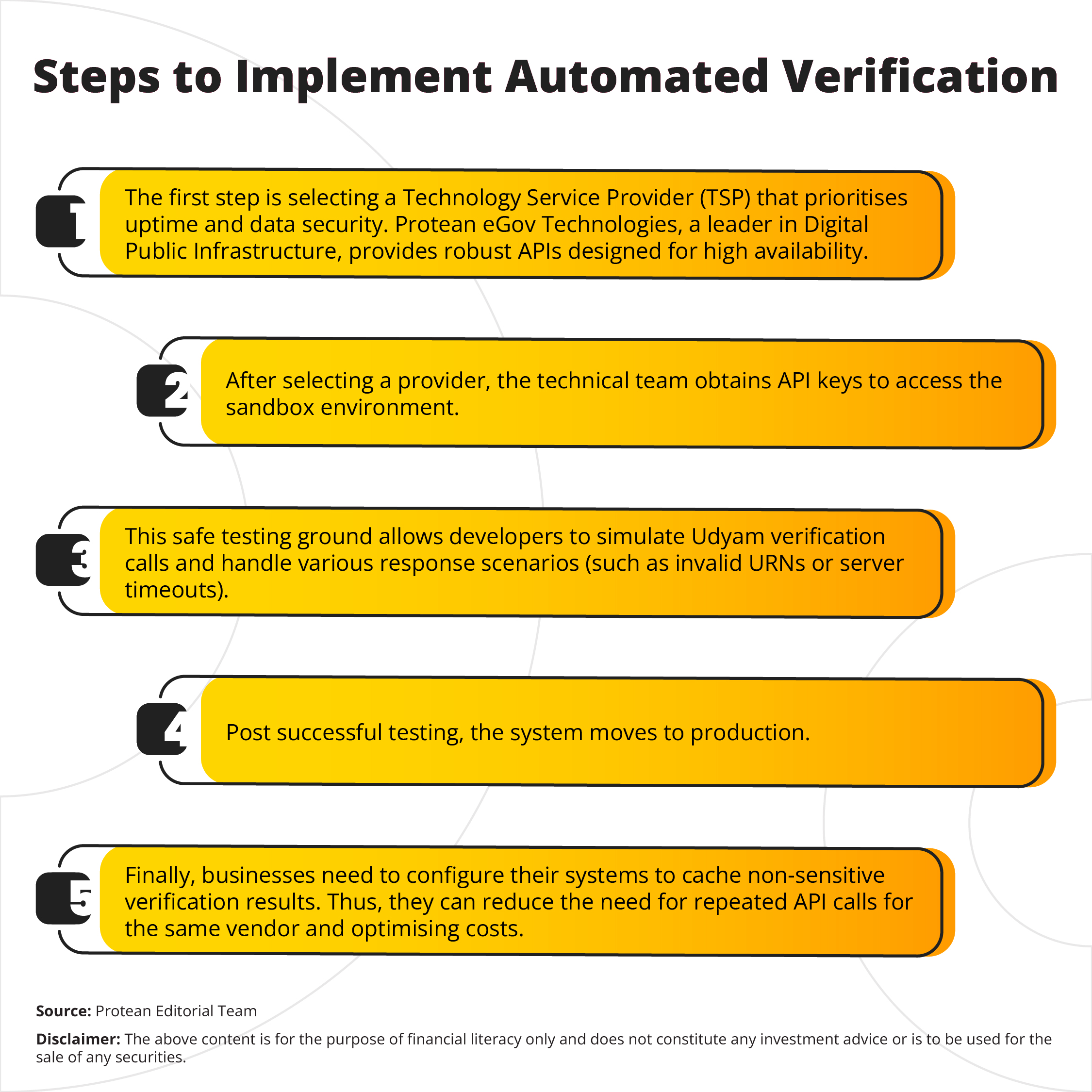
With these best practices you can ensure that the proprietor's identity matches the business credentials.
Conclusion: Final Recommendation
For any business processing more than 50 verifications a week, the manual public portal is obsolete. It creates an operational drag that is simply too high.
API integration is the only feasible method for high-volume environments. It offers the speed, accuracy, and scalability required to compete in 2026. As a result, it transforms compliance from a slow back-office chore into a real-time enabler of business growth.
Ready to accelerate your onboarding? Explore the Udyam verification API from Protean eGov Technologies to experience a leading API for Udyam verification.
Frequently Asked Questions
Q1: Is API integration for Udyam verification secure?
Yes. Reputed providers use banking-grade encryption (HTTPS/TLS) to ensure that data remains secure during transit. API integration ensures that sensitive business data is exchanged only between authorised systems.
Q2: Can the API handle bulk Udyam verification requests?
Yes. One of the main API integration advantages is the ability to process bulk requests. Businesses can upload a file with thousands of URNs, and the system will return the verification status for all of them rapidly, saving hundreds of man-hours.
Q3: Does the API provide details on the enterprise type?
Yes, a successful Udyam verification API call returns the specific classification of the enterprise (Micro, Small, or Medium). This data is important for banks to determine eligibility for specific government schemes and interest rate subsidies.