Electronic signatures commonly referred to as e sign or e signature have become the core of India’s transition toward a paperless, digitised documentation regime.
Financial institutions, regulators and pension-related mechanisms now routinely rely on e-signature workflows to accelerate onboarding, agreements and compliance filings. But for regulated sectors and high-value mandates, the questions persist.
- Is e signature legally enforceable?
- How robust is online signature or e sign validation for audits, legal disputes or long-term record-keeping?
Here is how the legal framework, the technical and compliance imperatives behind signature validation online, and what organisations should look for especially in contexts like the Pension Fund Regulatory and Development Authority (PFRDA)-governed National Pension System (NPS).
Legal Framework: What Indian Law Says
In India, electronic records and signatures have been legally recognised since the enactment of the Information Technology Act, 2000 (“IT Act, 2000”), along with subsequent amendments and rules.
- Under Section 5 of the IT Act, any law that requires a signature for authentication, if such signature is provided by compliant electronic means, it is deemed satisfied.
- The 2008 amendment expanded the recognition beyond cryptographic “digital signatures” to broader “electronic signatures,” including Aadhaar-based eSign methods.
- Consequently, an e-signed document cannot be invalidated simply because the signature is not physically handwritten.
For regulated flows like NPS, the acceptance of e signature is not just theoretical.
In fact, PFRDA has explicitly authorised Aadhaar-based eSign (with Aadhaar authentication) for NPS account opening. It is dispensing with the requirement to submit a physical application form.
This regulatory recognition signals that e signatures, once implemented under prescribed standards, enjoy the same enforceability and validity as traditional wet-ink signing.
How Strong Is Signature Validation Online?
Legal recognition aside, the real strength of e signature lies in validation, integrity, non-repudiation and audit readiness.
For an e-signed document to hold up under scrutiny, whether in compliance audits, regulatory review or court proceedings, certain technical and procedural criteria must be satisfied.
- Identity verification: Aadhaar-based e sign begins with e-KYC (OTP or biometric), which authenticates the signatory’s identity before the signature is generated.
- Cryptographic or certificate-backed signature: Either via a licensed Certifying Authority issuing a digital signature certificate (DSC/PKI-based), or via properly implemented Aadhaar e sign workflow, the process binds the signature to the individual securely.
- Immutable audit trail: A robust e sign system records metadata, certificate details, timestamp, document hash, signature events. This makes it possible to validate that the document has not been tampered with, and to trace who signed when.
- Evidentiary weight under law: Electronic signatures and records are admissible in Indian courts under the amended Evidence Act (via IT-Act provisions).
In short, when implemented with rigour i.e., secure identity verification, certificate-based signing, document hashing, timestamping and preserved audit logs, online signature validation is extremely strong.
Such records can withstand legal scrutiny, support compliance audits and substitute traditional signed paper agreements even in long-term record retention scenarios.
Types of E-Signatures and Their Security Profiles
Security is an important aspect in an e signature and here, not all are created similarly. In India, there are broadly three models in use. Each of them can be suitable to different risk levels, use-cases and regulatory contexts:
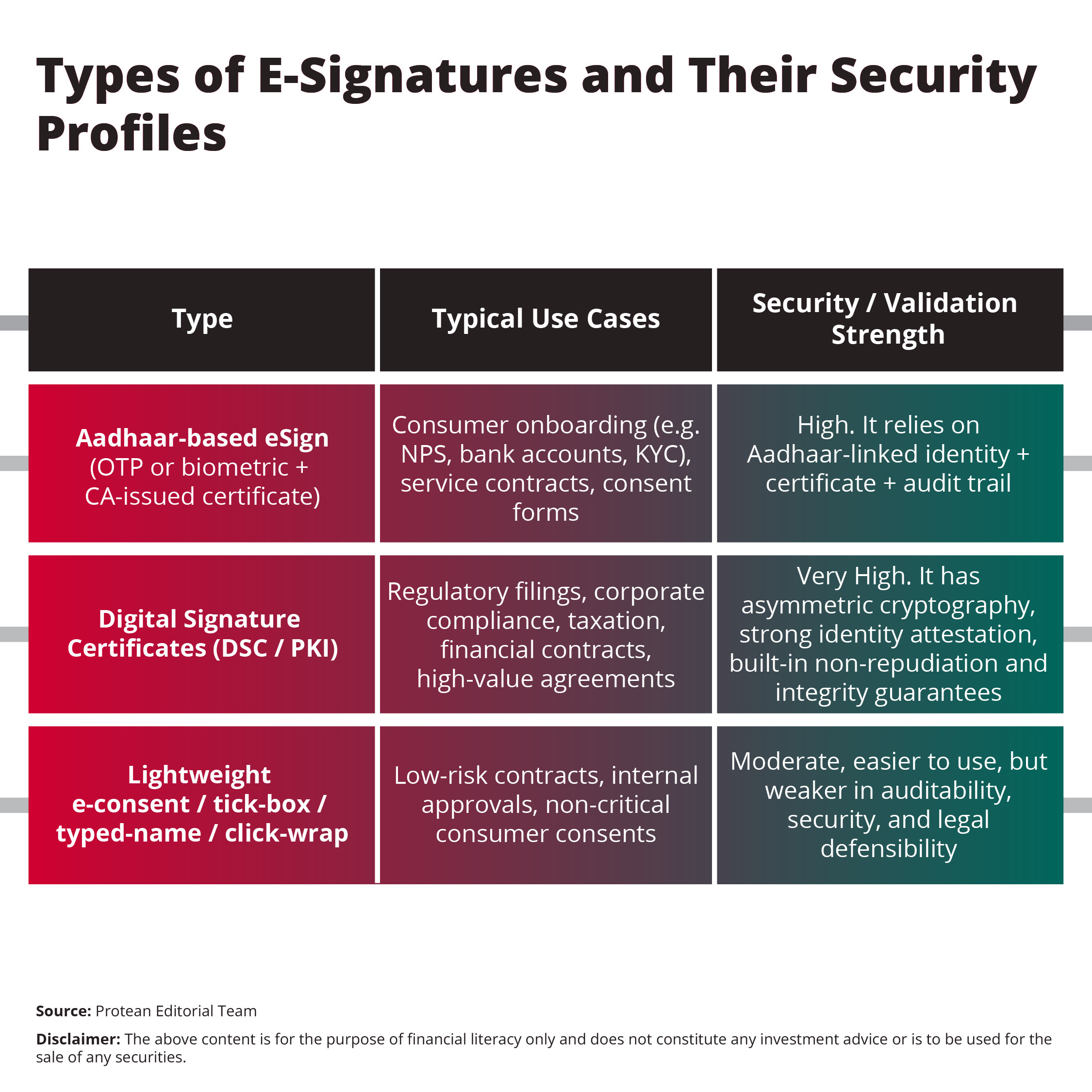
From a compliance, governance and risk-management standpoint, high-value or regulated use-cases (e.g. NPS subscription, loan agreements, securities, corporate filings) demand either Aadhaar-based eSign implemented via licensed Certifying Authorities, or DSC/PKI-based digital signatures. Lightweight e-consents may suffice only for low-risk, non-critical documentation.
For example, the NPS e-onboarding process under PFRDA now supports Aadhaar-eKYC + eSign.
This is an approach that combines speed, regulatory compliance and enforceable documentation without physical paperwork.
Practical Implications for Financial and Pension Systems (e.g. NPS)
The convergence of robust e-signature legal framework + secure technical implementation + regulator acceptance has concrete benefits for financial and pension systems in India:
Faster onboarding and reduced operational friction
With Aadhaar-based eSign and KYC, institutions can eliminate paper-based submission, physical verification or courier delays. For example, NPS subscribers can complete KYC, e sign the application form online and generate their PRAN digitally.
Lower compliance and archival costs
Digital records with certificate metadata and audit logs reduce the need for physical storage, manual filing, and long-term paper document management.
Improved audit readiness and legal defensibility
Properly implemented e-signature workflows with secured metadata (timestamps, certificates, audit trails) meet evidentiary requirements under Indian law. This makes them acceptable in court or regulatory investigations.
Enhanced user experience and scalability
For high-volume schemes (like NPS, APY, digital banking KYC), e-signature enables scale without proportional escalation in paperwork, while maintaining regulatory compliance.
Given the regulatory backing from PFRDA and the legal foundation under the IT Act, e sign now represents a mature, operationally viable alternative to traditional paper-based procedures.
Conclusion
An e signature in India is structurally and operationally robust when implemented under prescribed norms. With secure identity verification, certificate-based signing, immutably logged metadata and compliant archival practices, e-signed documents carry substantial legal and evidentiary weight.
The adoption of Aadhaar-based e sign by regulators like PFRDA for schemes such as NPS underscores growing institutional confidence. For organisations and financial institutions, the key is to work only with licensed Certifying Authorities or trusted e sign service providers, embed end-to-end audit trails, and ensure compliance with the IT Act and supporting regulations.
Frequently Asked Questions
Q1: Are Aadhaar-based eSignatures as valid as DSCs?
Yes. Both DSC and Aadhar e sign are legally valid. DSCs can be better for regulatory filings and Aadhaar eSign can be better for large-scale digital onboarding.
Q2: Can an e-signed document be challenged in court?
Only if the signing process lacks proper authentication and audit proof. Otherwise, a compliant e-signed record is fully admissible.
Q3: What is required to validate a signature online?
Check the certificate, timestamp, audit trail and document hash to ensure the signature and file haven’t been tampered with.
Q4: Are there documents where an e signature isn’t allowed?
Yes. There are a few documents like wills, trusts, powers of attorney, negotiable instruments (except cheques), and some property sale documents for which physical signatures are still required by law.