A CKYC solution can advantage businesses far beyond simplifying onboarding. In 2026, the Indian financial services sector is set for a major transformation. Aspects such as strict regulatory mandates, fraud escalations, and rising consumer demand for hassle-free services are at the forefront of expected change.
Centralised Know Your Customer (CKYC) is no longer a basic compliance checkbox. It is a foundational layer of digital trust and institutional resilience. Thus, CKYC integration is a strategic need to do the following.
- Navigate DPDP (Digital Personal Data Protection) enforcement
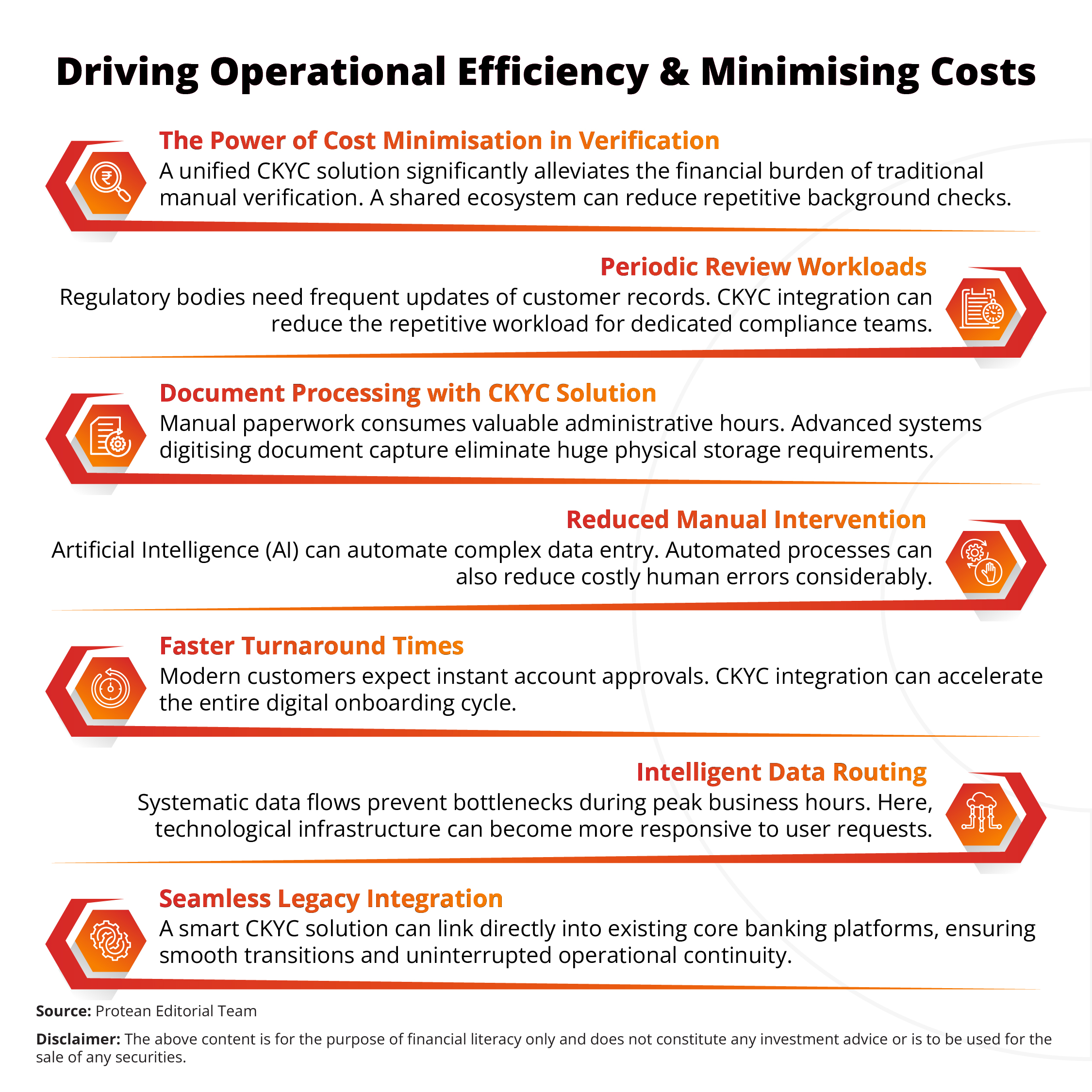
- Reduce costs
- Scale customer acquisition
With a strategic CKYC integration, businesses can achieve enhanced compliance and unlock new dimensions of sustainable financial growth. Here are the top reasons for adopting CKYC for India’s financial growth in 2026.
Navigating through the Complex Regulatory Landscape
Here’s how CKYC solutions can help businesses manage regulatory compliance.
Alignment with the DPDP Act and Consent Management
The DPDP Act 2023 has enforced strict guidelines for consumer privacy. With a reliable CKYC solution, financial entities can securely handle sensitive data. Businesses can adopt Protean eGov Technologies’ robust frameworks to flawlessly manage user consent. They can also avoid regulatory penalties when their backend systems align with these strict mandates.
Adhering to RBI’s Secured Lending & Capital Market Norms
Banks and non-banking financial companies need to follow rigid reserve bank directives. A compliant CKYC integration would align with capital market rules, perfectly. This is a systematic approach that can shield institutions from regulatory backlash. Protean eGov Technologies can ensure that businesses meet all these structural requirements without fail by providing solutions. This can contribute to a more stable and secure financial ecosystem for all participants.
Providing the Identity Backbone for Verified Communications
With CKYC integration, businesses gain the identity backing to guarantee that authorised communications reach the correct, verified recipient. Verified identity records can also help in minimising the chances of unauthorised access to financial channels. Institutions can thus secure their transactional integrity by using CKYC solutions. Businesses require an updated CKYC solution to maintain trust and continuous regulatory alignment across the board.
Defenses Against Next-Gen Financial Fraud
Financial fraud techniques are evolving continuously. They exploit system vulnerabilities, requiring entities to build strong defenses to protect valuable digital assets. An integrated CKYC solution could effectively mitigate these risks. Here’re eight ways a CKYC integration could prevent next-generation financial fraud.
- Real-time database deduplication can prevent malicious individuals from opening multiple illicit accounts.
- Advanced image recognition can instantly identify forged verification documents.
- Sophisticated machine learning algorithms can instantly flag suspicious onboarding patterns.
- Centralised national registries can lock-out known fraudulent identities across all financial sectors.
- Artificial intelligence-driven liveness checks can shield against deepfake video spoofing attempts.
- Encrypted data vaults can protect sensitive customer information from unauthorised external breaches.
- Automated audit trails can track every data access request transparently.
- Secure application programming interfaces can protect the data transmission against malicious interception.
Transforming Customer Experience
Here’s how integrating CKYC can help transform customer experience.
Instant Account Activation
Modern consumers demand immediate financial results. With CKYC integration, businesses can fetch pre-verified data in real-time, moving customers from account opening to transaction readiness within a few minutes.
Elimination of Repetitive Paperwork
In traditional, systems, clients often need to repeatedly share the same identity documents across different entities. A verified CKYC solution can utilise the central registry to quickly fetch existing records.
Frictionless Cross-Sector Journeys
An investor opening a bank account and buying mutual funds simultaneously would require a ‘Unified’ user profile.
Enhanced Digital Trust
Customers’ security depends on institutions utilising recognised national compliance standards. This institutional trust can build long-term loyalty for your financial brand.
Omnichannel Accessibility
Users can initiate product applications on mobile devices and complete them on home desktops. The centralised backend can support consistent digital experiences across all platforms.
Scaling Financial Inclusion and Rural Outreach
Here’re ways in which CKYC can help scale financial inclusion and rural outreach.
Empowering Business Correspondents (BCs) for Remote KYC
Generally, rural geographical areas lack physical bank branches. Financial institutions can use authorised business correspondents, bridging this huge gap. A portable CKYC solution can empower these local agents to verify identities on the spot. With a mobile CKYC integration, field agents can onboard villagers without requiring physical paper documents.
Overcoming Connectivity Barriers
Internet network access could be inconsistent in many remote regions. To overcome these barriers, institutions are adopting a hybrid model that combines physical and digital verification. With this hybrid approach, institutions can meet on-ground realities and drive true financial inclusion nationwide.
Conclusion
In 2026, integrating a CKYC solution in 2026 is the strategic anchor for digitally mature financial operations across India. Institutions can utilise a seamless CKYC integration, thus, effectively managing complex compliance rules within the market.
A unified CKYC solution transforms frustrating regulatory hurdles into lucrative business growth opportunities.
Connect with Protean eGov Technologies today to streamline your CKYC integration and firmly future-proof your entire compliance infrastructure for the decades ahead.