Security is one of the most important goals when it comes to financial services. Aadhaar OTP verification can help financial services companies achieve this goal without compromising on speed and accuracy.
Customers of financial services businesses expect instant access to their bank accounts, loans, and insurance policies. The Aadhaar OTP verification process is an important "Paperless Revolution" in India.
With Aadhaar verification online, businesses can immediately validate a person’s identity through a simple six-digit code sent to a registered mobile number. This digital method considerably reduces the need for heavy documentation and physical signatures. Thus, users can experience a seamless transition from registration to service activation with Aadhaar eKYC.
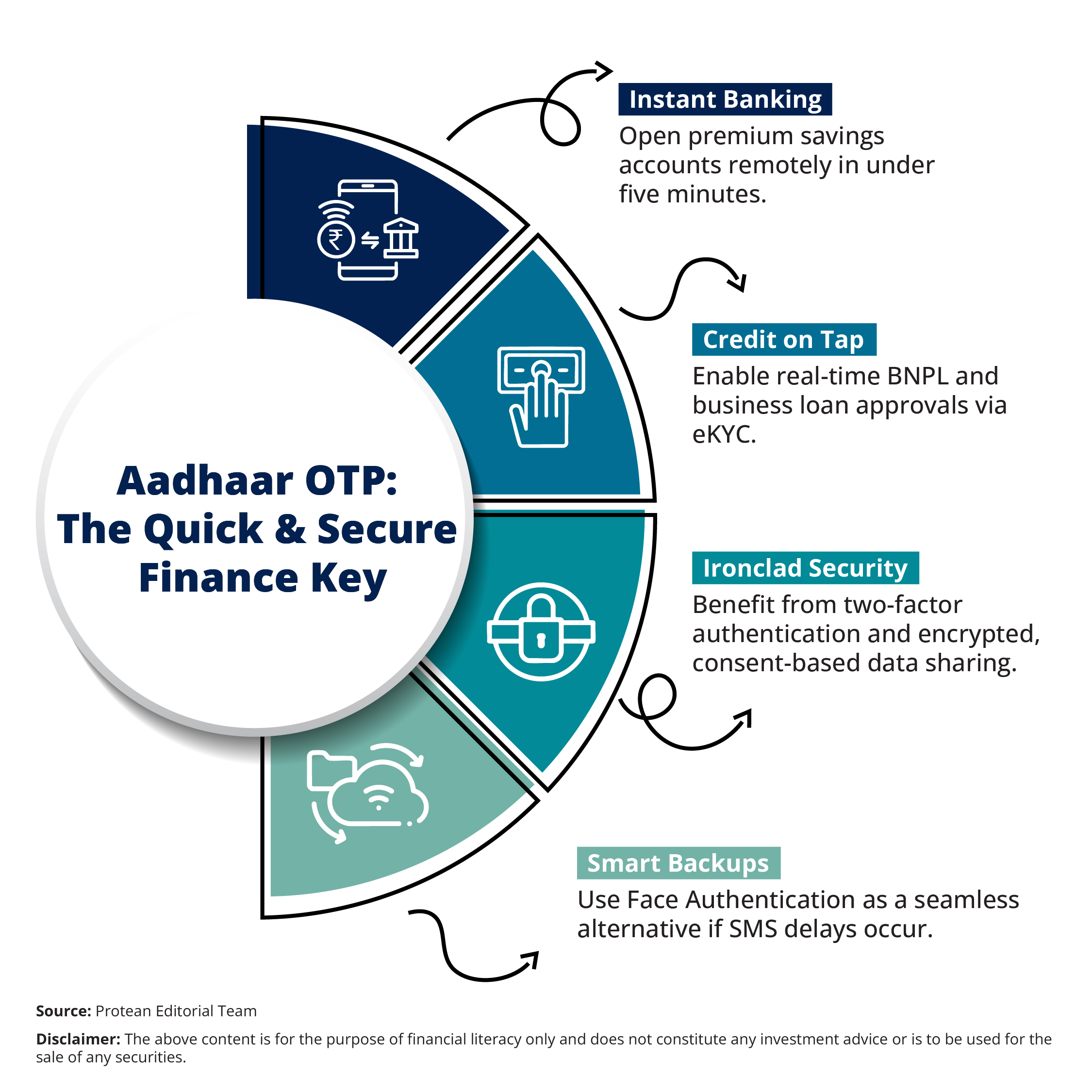
Instant Banking: From Zero to Account in 5 Minutes
There is a huge difference between the traditional banking methods and the current Aadhaar eKYC process. Here is how Aadhaar verification online technology has transformed India’s banking industry.
Paperless & Remote Availability
Earlier, a bank account opening required physical presence and multiple photocopies of identity proofs. However, the digital framework results in almost instant identity verification of customers. Now, with the Reserve Bank of India (RBI) guidelines, users in every corner of India can open a savings account through Aadhaar verification online.
Seamless PAN-Aadhaar Integration
The mandatory PAN-Aadhaar link can lead to successful Aadhaar OTP verification for the retrieval of verified demographic data from the central database. Protean eGov Technologies provides the essential API stack that facilitates this real-time exchange of information between banks and the government.
Reduced Risk of Manual Errors
The Aadhaar data originates from a secure source. So, banks can considerably reduce the risk of manual entry errors. With this level of automation, a new customer can move from zero to an active bank account in just a few minutes.
How Aadhaar eKYC Gets Approved While You Wait
Here is how fintech platforms have transformed the lending sector through the use of Aadhaar eKYC.
- Ease of BNPL - Fintech firms pull verified credit data and personal information to offer instant loan disbursements to qualified applicants. The role of Aadhaar verification online becomes evident during "Buy Now, Pay Later" (BNPL) transactions at various points of sale. A shopper receives a credit limit in real-time as they complete their purchase through a secure Aadhaar OTP verification.
- Small entrepreneurs - Small businesses can also utilise this technology to verify their business identities for fast-track working capital loans. With quick capital accessibility, businesses can secure funds exactly when they require them for expansion or inventory.
- Accuracy & risk management - Aadhaar verification enhances accuracy in customer onboarding, supporting robust risk assessment models.
- Business cost optimisation - Paperless loan applications can reduce the operational costs for fintech startups. As a result they can have better chances to gain more competitive interest rates for the borrower.
- Enhanced trust - The presence of Aadhaar verification online builds a layer of trust between the lender and the borrower.
Importance of Security and Privacy in the Digital Age
The Aadhaar eKYC ecosystem is based on the fundamental principles of security and privacy.
Advanced Encryption - The system uses advanced encryption standards to protect the demographic data of every citizen during transmission.
Explicit User Consent - Every Aadhaar OTP verification requires explicit user consent, significantly reducing unauthorised access to personal records.
Robust & Scalable Infrastructure - Protean eGov Technologies maintains a robust, scalable infrastructure for tamper-proof, authentic data mapping.
Reduced Risks of Frauds & Identity Theft - Unlike physical identity cards, the digital OTP is linked to a specific mobile number with a limited validity period, making this two-factor method effective against identity theft and financial fraud.
Strict Data Protection Laws - Regulators like UIDAI monitor Aadhaar verification to ensure financial institutions follow strict data protection laws; users retain full control via secure Aadhaar features.
Transparency - The transparent nature of Aadhaar eKYC ensures that every access to personal data has a clear and recorded purpose.
When the OTP Fails: Use-Case Scenarios
Here is how businesses can avoid technical issues from disrupting the flow of Aadhaar OTP verification.
Mobile Number Mismatch
Mobile numbers failing to match the UIDAI database is one of the most common reasons for OTP failure. You need to ensure that your current SIM card is linked to your Aadhaar profile.
SMS Delay
Users need to effectively manage the 10-minute validity window for each 6-digit code. An SMS delay can occur due to network congestion. Here, you can quickly check the signal strength to resolve the issue. Modern financial services also offer Face Authentication as a seamless backup, to manage OTP issues. With this multi-modal approach, customers can continue their Aadhaar eKYC process without a total exit from the application.
Failure to Update Details
Users need to update any changes in contact details at an authorised center. Digital platforms can provide clear error messages to the users. This can guide the user through alternative Aadhaar verification online paths.
Older App Versions
You can access Aadhaar eKYC services during non-peak hours for faster response times from the central server.
Conclusion: Aadhaar eKYC is the Strategic Differentiator
The Aadhaar OTP verification process supports frictionless onboarding for low-risk financial services in India. It streamlines access to credit, insurance, and banking services for eligible low-risk customers in India.
The integration of AI-driven fraud detection systems can make the use of an OTP safer and faster than any paper-based method. Financial institutions can prioritise Aadhaar eKYC to gain a competitive edge by offering superior user experiences.
With Aadhaar eKYC, the era of paper-based hurdles has finally come to an end. Now, Aadhaar verification has set higher standards for a secure and progressive financial journey.
Frequently Asked Questions (FAQs)
Q1: Does Aadhaar OTP verification work for all types of bank accounts?
Major banks use Aadhaar eKYC for services related to opening savings and current accounts for individual customers. However, certain high-value corporate accounts may require additional physical checks under specific bank policies and enhanced due diligence requirements.
Q2: How many times can I request an Aadhaar verification online in a day?
UIDAI imposes restrictions on OTP requests, such as a maximum of 5 per Aadhaar within 30 minutes for specific services; excessive attempts may trigger temporary locks. Users should wait for the 10-minute window to expire before they request a new code to avoid temporary system locks.
Q3: Is the Aadhaar eKYC process legally valid for insurance policies?
Yes, the Insurance Regulatory and Development Authority of India (IRDAI) accepts Aadhaar eKYC as valid identity and address proof. This allows for the instant issuance of digital insurance policies without physical paperwork or lengthy wait times.