If you search “Aadhaar eSign benefits” on the internet, you will find tons of articles stating that it’s a business necessity.
In 2026, the Indian financial sector has considerably evolved from the paper-heavy routines of the past.
Today, every transaction is a "Digital Handshake." BFSI (Banking, Financial Services, and Insurance) institutions operate in an environment where speed and security are extremely important.
Businesses can facilitate a seamless, legally binding agreement between a service provider and a customer by adopting Aadhaar eSign. It considerably reduces the need for a physical meeting.
With transforming digital public infrastructure, reliance on electronic signatures has become a mandatory standard for any institution including BFSI.
This shift has ensured that trust in BFSI can remain digital and verifiable at key customer journey touchpoints.
Why Physical Signatures are a Liability
The traditional "wet-ink" signatures have become a thing of the past. They are a major bottleneck and a security risk for modern BFSIs businesses.
Physical documents can be forged, tampered, and prone to simple human error during the filing process.
Furthermore, there is a logistical burden of printing, couriering, and storing paper records. These expenses add large overhead costs to every transaction. The delay in physical signing processes can also lead to customer drop-offs.
For example, a customer waiting three days for a courier to deliver a loan agreement might find a faster alternative. But Aadhaar eSign can considerably reduce these delays and provides a tamper-evident digital seal.
With this technology, the content of a document would remain unchanged even after the signature is applied. As we move away from paper, an institution’s inherent digital vulnerabilities are reduced and their overall audit readiness is improved.
Your Fingerprint is Your Password
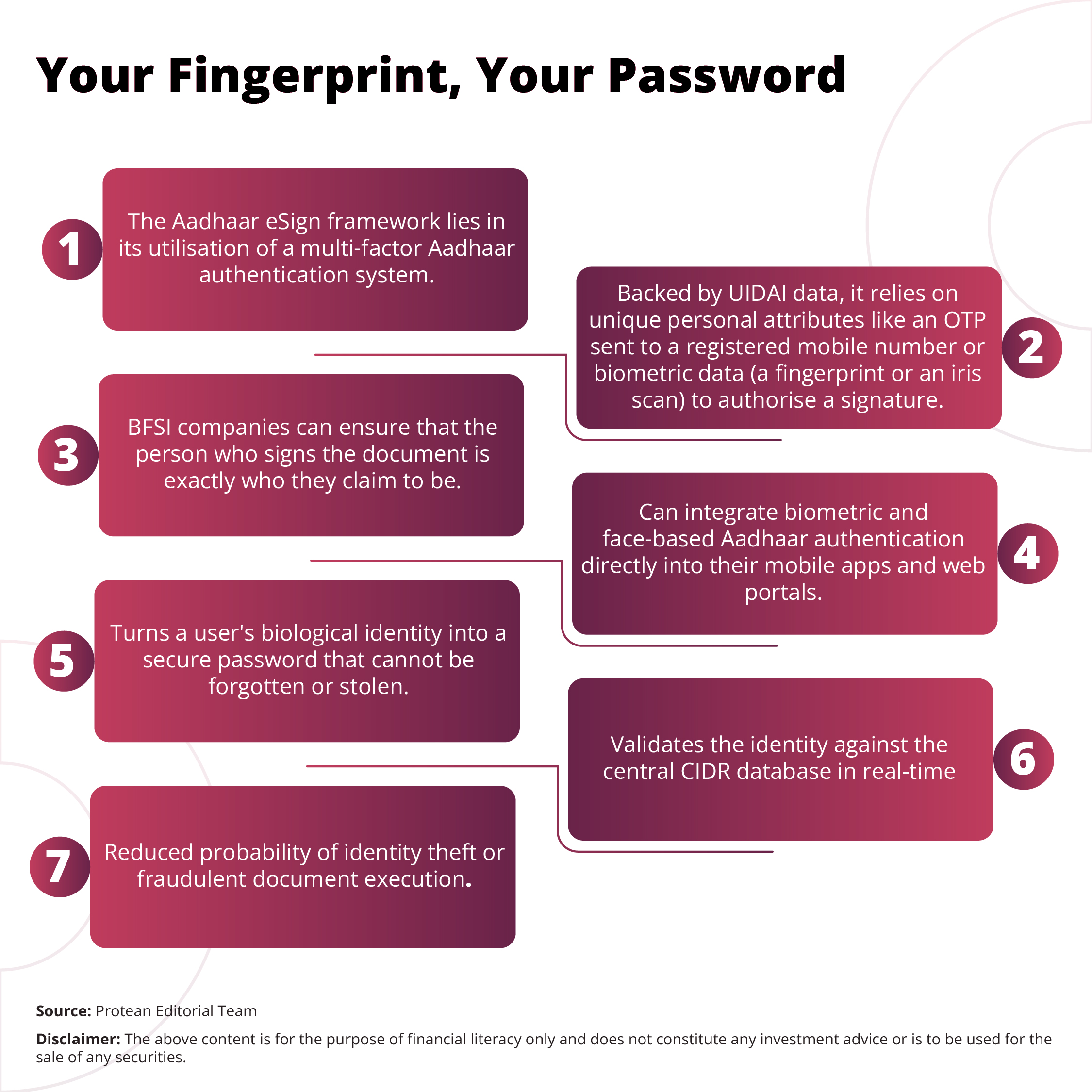
The Aadhaar eSign framework lies in its utilisation of a multi-factor Aadhaar authentication system.
A digital signature backed by UIDAI data relies on unique personal attributes. A subscriber uses either an OTP (One-Time Password) sent to a registered mobile number or biometric data, such as a fingerprint or an iris scan, to authorise a signature. Thus, BFSI companies can ensure that the person who signs the document is exactly who they claim to be.
With Protean eGov Technologies BFSIs can integrate biometric and face-based Aadhaar authentication directly into their mobile apps and web portals.
The Aadhaar eSign process turns a user's biological identity into a secure password that cannot be forgotten or stolen. The system validates the identity against the central CIDR database in real-time. Thus, with Aadhaar eSign, the probability of identity theft or fraudulent document execution drops to near zero.
The Customer Experience Revolution
Over the last few decades, customer expectations have evolved rapidly. The demand for "instant everything" is dominating the financial world.
Aadhaar eSign integration in onboarding workflows has led to transforming how customers perceive banking and insurance services. The days when a person visited a branch multiple times to submit various forms have become a thing of the past.
A modern customer can complete an entire life insurance application or a demat account opening using a smartphone in just a few minutes.
BFSIs can use Aadhaar eSign solutions from Protean eGov Technologies to experience reduction in TAT (Turnaround Time).
When a bank approves a personal loan within minutes of the application because the contract was signed via an Aadhaar eSign, it can set a high bar for the entire industry.
With technological scalability institutions can handle crores of transactions simultaneously. Aadhaar eSign can also increase financial inclusion by reaching customers in remote rural areas who lack easy access to physical branches.
The paperless approach of Aadhaar eSign can further align with global sustainability goals, with BFSIs reducing their carbon footprint.
Understanding Your Rights in the Digital Age
The Information Technology Act, 2000, has granted Aadhaar eSign the same legal status as a physical signature. Meaning, a digitally signed contract is fully enforceable in a court of law. However, this validity depends on the use of licensed CAs (Certifying Authorities) such as Protean eGov Technologies.
Data privacy is a top priority in this digital era. So, every Aadhaar authentication event requires the explicit user consent. Institutions need to clearly state the authentication purpose and ensure that they do not store sensitive data like the Aadhaar number or OTP, in accordance with UIDAI regulations.
Users can track their authentication history through the UIDAI portal. This provides a layer of transparency that was never possible with paper documents.
The Takeaway - Embracing the Paperless Future
Aadhaar eSign adoption is essential for staying competitive in digital operations. The Aadhaar eSign technology offers strong legal validity, low costs, and high security.
Protean eGov Technologies can be your trusted partner in this journey. It provides the API-first solutions necessary to digitise complex financial workflows.
Thus, BFSIs hesitating to move away from legacy systems risk obsolescence in a market that prizes speed and digital accessibility.
Embracing the Aadhaar eSign framework has a considerable competitive advantage. Aadhaar eSign features are designed to reduce costs, minimise fraud, and deliver the seamless experience that modern consumers demand.
Finally, it is a complete reimagining of the trust relationship between a financial institution and its customers.
Frequently Asked Questions
Q1: Is an Aadhaar eSign legally valid for all types of financial contracts?
Yes. Aadhaar eSign technology carries full legal validity under the Information Technology Act for most financial documents. These include loan agreements, insurance policies, and account opening forms. But certain documents like wills or real estate sale deeds might still require physical execution (as per specific state laws).
Q2: How does an Aadhaar eSign prevent the forgery of documents?
The Aadhaar eSign system applies a cryptographic hash to the document at the time of signing. Any attempt to alter the text or data after the Aadhaar eSign is affixed would break the digital seal. This makes the tampering immediately visible to any person who is verifying the document.
Q3: What happens if a customer does not have a mobile number linked to Aadhaar?
OTP-based signing requires a registered mobile number. If a customer lacks this, BFSIs use biometric-based Aadhaar authentication (fingerprint or iris) or face authentication via a compatible device to facilitate the signing process without a mobile OTP.
Q4: Are there any hidden costs for a business using Aadhaar eSign?
No. The cost structure is transparent. BFSIs usually pay a small fee per signature to the eSign Service Provider (ESP). This cost is a tiny fraction of the expenses related to paper, printing, and physical storage.